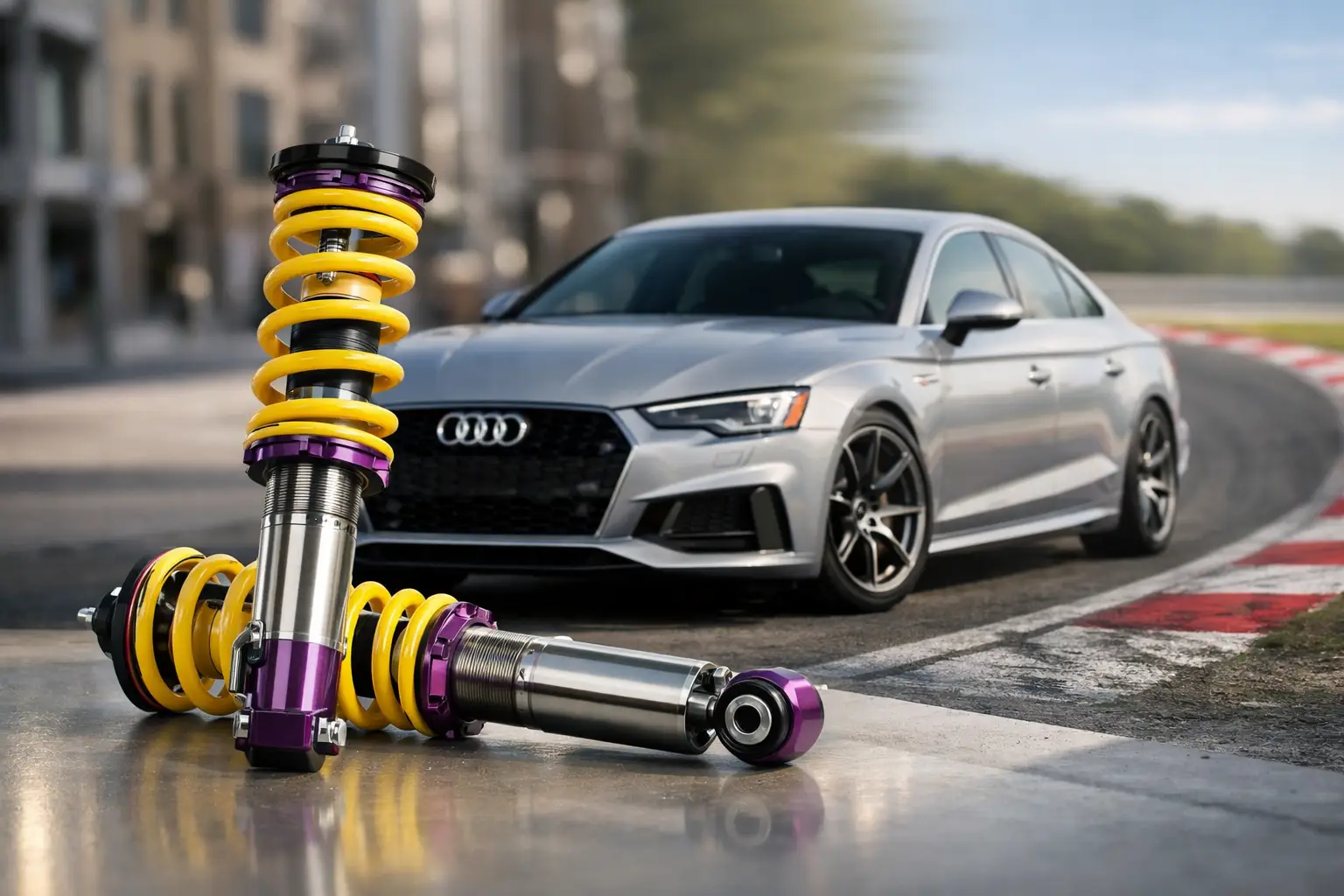
A fast Audi can feel expensive and underwhelming at the same time if the suspension is wrong. Too soft, and the car rolls over onto the outside tires and loses precision. Too stiff, and it skates across broken pavement, fights for traction, and becomes miserable to drive. That is why choosing coilovers for Audi street and track use is less about chasing the hardest spring rates and more about matching the suspension to the chassis, tire, power level, and the way the car actually gets used.
What makes coilovers for Audi street and track different?
A true dual-purpose setup has to do two jobs that often pull in opposite directions. On the street, you want compliance over expansion joints, dips, uneven pavement, and the kind of rough surfaces that can upset an overly aggressive setup. On track, you want body control, predictable weight transfer, and damping that can keep the tire planted under hard braking, quick direction changes, and corner exit power.
That balance matters even more on Audi platforms because the lineup covers very different starting points. An MQB S3 or RS3 behaves differently than a B9 S4, and both differ again from a TTRS. Weight distribution, front axle load, wheelbase, factory suspension geometry, and drivetrain all change what a good setup looks like. The right coilover package for one Audi can be completely wrong for another, even if both cars make similar power.
Start with the real use case, not the marketing pitch
The biggest mistake buyers make is shopping by label. Plenty of kits are marketed as street and track capable, but that phrase can mean anything from mildly firmer than stock to fully aggressive suspension that belongs on a car trailered to events.
If your Audi sees 90 percent street driving and a few HPDE weekends per year, the right coilover usually has moderate spring rates, quality dampers, good corrosion resistance, and enough adjustment to fine-tune the car without turning setup into a full-time job. If the car spends most of its life on track, then stiffer rates, more damper control, camber support, and thermal consistency under repeated hard laps become much more important.
There is no prize for buying more suspension than you can use. In fact, overshooting often makes the car slower and less enjoyable.
Spring rates and damping matter more than ride height
A lot of buyers start with stance. Ride height matters, but it is only one piece of the package. A lowered Audi with poor damper control will usually perform worse than a properly valved setup at a more conservative height.
Spring rate sets the baseline for how much the car resists pitch and roll. Damping controls how that motion happens. If the spring is too stiff for the damper, the car feels busy and unsettled. If damping is too aggressive for the road, the suspension cannot recover properly between bumps. That is where many cheap kits fall apart. They may offer a dramatic drop and plenty of adjustability on paper, but the actual calibration is not refined enough for a serious dual-purpose car.
For street and track use, a quality monotube design is often preferred because it handles heat well and tends to deliver better damper control under repeated hard use. Twin-tube designs can still work well on certain street-focused applications, but once pace rises and track sessions get longer, damper consistency becomes harder to ignore.
The best coilovers for Audi street and track cars share a few traits
The strongest options tend to get the fundamentals right before adding complexity. They use damper valving that matches the spring package, offer a ride height range that preserves suspension geometry, and come from manufacturers with real platform development behind them.
You also want hardware quality that matches the car. Audi owners dealing with year-round weather should pay attention to corrosion resistance, threaded body protection, and long-term serviceability. A premium kit costs more up front, but that cost usually buys better ride quality, more predictable handling, and fewer headaches when it is time to adjust or rebuild the suspension later.
Camber capability is another major factor. On many Audi applications, front-end grip is limited by geometry and tire management as much as raw suspension stiffness. If you plan to run square wheel setups, sticky tires, or repeated track days, top mounts and alignment flexibility become a real advantage. Without enough front camber, the outside shoulders of the tires take a beating and the car pushes sooner than it should.
Audi chassis differences change the answer
It is tempting to ask for one best setup across the entire brand, but Audis do not respond the same way to the same suspension philosophy.
MQB Audi S3 and RS3
These cars reward suspension that improves front-end precision without making the rear nervous on the street. The RS3 especially can respond very well to a coilover setup that controls dive and roll while keeping enough compliance to put power down on imperfect pavement. Too much rear stiffness can make the car feel edgy, while too much front stiffness can amplify understeer instead of reducing it.
TTRS
The TTRS is compact, fast, and very sensitive to setup quality. A good coilover package can sharpen the car dramatically, but because the chassis is already responsive, poor damping choices show up quickly. It does not take much to turn a capable road and track car into something harsh and overly reactive.
B8 and B9 S4 or S5
These platforms often benefit from a more balanced approach. They are heavier than the compact Audi options, and owners usually expect a higher level of street comfort. For that reason, damper quality matters as much as outright stiffness. The goal is usually to improve control and reduce float without creating a ride that feels cheap or punishing.
One-way, two-way, and adjustable damping
More adjustment is not automatically better. For most enthusiasts running mixed street and track miles, a well-developed single-adjustable kit is often the sweet spot. It gives enough range to tighten the car for events and soften it for normal driving without adding unnecessary complexity.
Two-way systems can be excellent, especially for advanced drivers chasing lap time or refining balance around specific tires and tracks. But they also require more understanding. If you do not know how rebound and compression changes affect the car, extra knobs can become expensive confusion.
That is why support matters. A premium supplier should help match the product to the car and the driver, not just sell the highest-priced option on the page. At EAS Store, that consultative approach is a major part of getting serious parts selection right.
Supporting mods can make or break the result
Coilovers do not work in isolation. If you install a premium kit on worn control arms, old mounts, tired sway bar links, or poor tires, you will not get the result you paid for.
Alignment is the most overlooked part of the entire upgrade. Even the best coilovers for Audi street and track driving will disappoint if toe and camber are not set correctly for the intended use. A street-biased alignment may preserve tire life and daily manners, while a more aggressive track alignment can unlock front-end grip and improve turn-in. The trade-off is usually increased tire wear and a little more tramlining on the road.
Tires are just as important. Suspension can only manage the contact patch it has. If the tire overheats quickly or the sidewall does not match the car’s weight and pace, the suspension cannot fully compensate.
When to avoid going too low
Lower is not always faster. Once ride height starts to compromise shock travel, roll center behavior, bump compliance, or axle geometry, the car can lose grip and become less predictable. This is especially relevant on Audis that are driven hard on real roads instead of smooth show surfaces.
A useful street and track setup usually aims for functional ride height rather than minimum ride height. You want enough drop to reduce excess wheel gap and sharpen response, but not so much that the car bottoms out, rubs under compression, or burns through suspension travel in the first half of a corner.
How to choose the right kit
The right buying questions are straightforward. How often will the car see track time? Are you willing to compromise ride comfort for pace? Do you need top mounts and camber adjustment? Will the car run aggressive tires, wider wheels, or upgraded sway bars? Are you looking for a set-it-and-forget-it setup, or do you actually want to tune damping and height regularly?
If the car is primarily street-driven, focus on refined damping, durability, and a realistic ride height range. If it is a serious track build, prioritize heat control, chassis support, alignment flexibility, and spring and damper options that can scale with the car as grip and speed increase.
The best answer is rarely the cheapest kit and rarely the most extreme one. It is the suspension package that matches the Audi in front of you and the way you intend to drive it.
A good coilover setup should make the car feel more honest. Turn-in gets cleaner, braking gets calmer, mid-corner balance becomes easier to trust, and the car puts power down with less drama. That is the standard worth paying for, because when the suspension is right, every other performance upgrade gets easier to use.