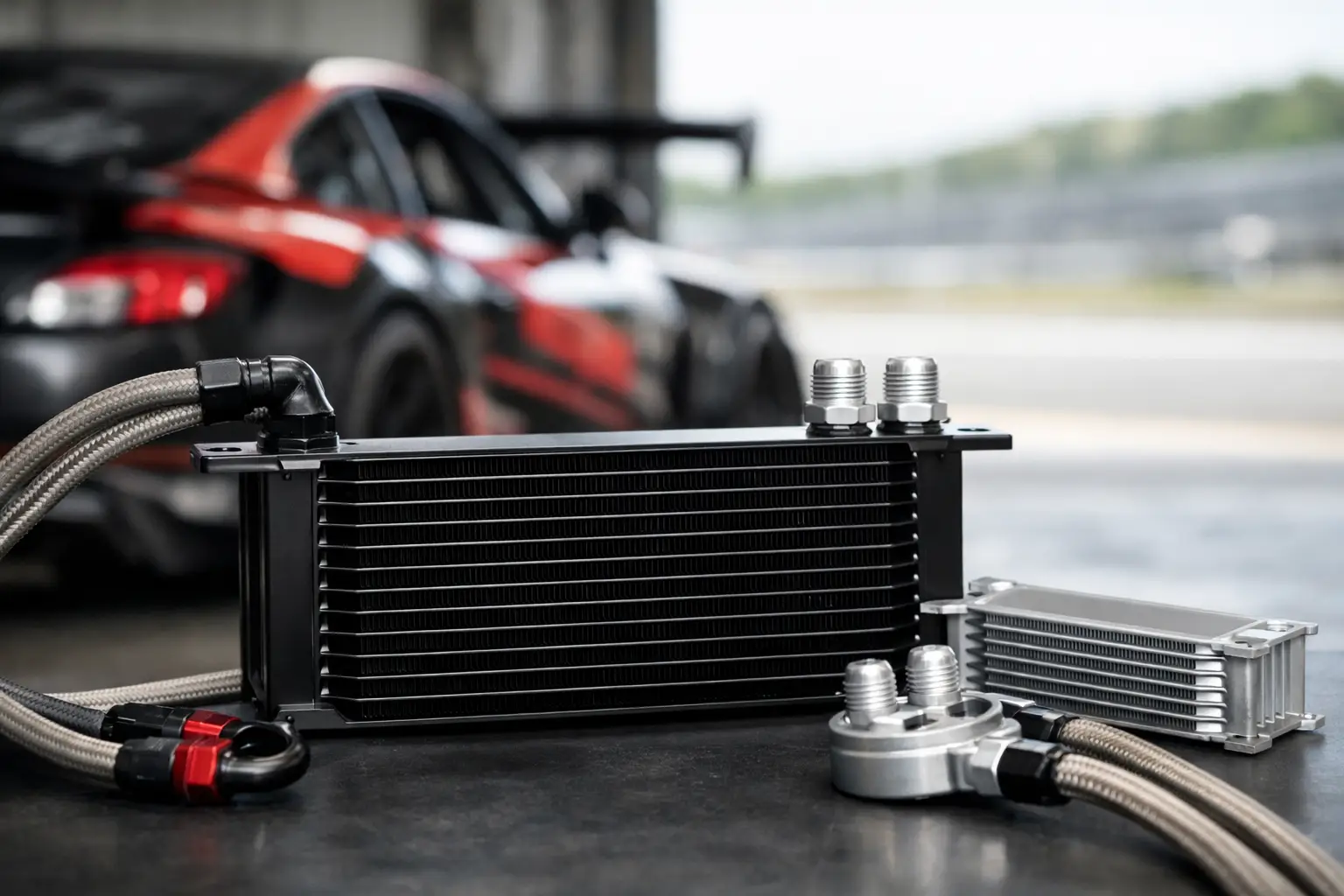
A hard-pulled TTRS can feel brutally fast on the first hit, then noticeably softer once heat starts stacking. That is exactly why an audi ttrs intercooler upgrade lands so high on the priority list for tuned 2.5 TFSI owners. On this platform, charge air temperature control is not a small detail – it directly affects consistency, timing, knock resistance, and how confidently the car holds power run after run.
Why the factory intercooler becomes a limit
The stock TTRS intercooler is not a bad part for a factory calibration and normal street use. Audi gave the car a capable package, and for a stock or lightly driven car, it can do its job well enough. The problem shows up when boost increases, ambient temperatures climb, or the car sees repeated acceleration instead of a single short pull.
Once you start adding power, the factory core has less room to absorb and shed heat. Intake air temperatures rise more quickly, and the ECU responds the way it is designed to respond – by protecting the engine. That can mean reduced timing, less aggressive power delivery, and a car that feels less impressive on the second or third run than it did on the first.
For enthusiasts chasing dependable performance, that inconsistency matters just as much as peak dyno numbers. A faster car on paper is one thing. A car that repeats that performance in traffic, on back roads, at a roll-racing event, or during a track session is something else.
What an Audi TTRS intercooler upgrade actually improves
An upgraded intercooler is really a temperature management upgrade. The goal is to lower charge air temperatures and slow the rate of heat soak so the engine can operate in a more stable window. On the TTRS, that stability pays off in several ways.
The first is consistency. A better core usually keeps intake temperatures under control for longer, so the car feels more like the same car on every pull. The second is tuning headroom. If your calibration is asking more from the turbo system, cooler charge temps support that request with less stress and less likelihood of the ECU pulling things back.
There is also a reliability angle. High-performance turbo engines reward good thermal control. Lowering charge temps does not magically remove all risk from a hard-driven car, but it helps reduce one of the major bottlenecks in a tuned forced-induction setup.
That said, an intercooler is not a miracle part. If someone expects huge gains from an otherwise stock car with no heat-related limitations, the change may feel modest in cool weather. The bigger the boost increase and the harder the use case, the more valuable the upgrade becomes.
When you should upgrade the intercooler
If your TTRS is staying stock and living a comfortable street life, the factory intercooler may be fine longer than internet discussions suggest. But once the car moves into stage 1, stage 2, ethanol blending, hybrid turbo territory, or repeated high-load driving, the stock unit starts looking less like a strength and more like a restriction.
For most owners, the sweet spot is upgrading early in the build rather than waiting until the car is already showing signs of heat-related performance drop. If you are planning software, downpipe, intake, or a more aggressive fuel strategy, the intercooler should be part of the same conversation. It is easier to build a balanced package than to chase temperature issues after the fact.
Track drivers and drag racers should be even more direct about it. Repeated full-throttle operation is where a larger, more efficient core earns its keep. Street-only owners in cooler climates may have more flexibility, but hotter regions and stop-and-go summer driving can expose the stock system quickly.
Choosing the right Audi TTRS intercooler upgrade
Not every intercooler upgrade is the right one for every car. Core size matters, but it is not the only variable worth paying attention to. A very large core can improve cooling capacity, but if the design sacrifices airflow efficiency or creates unnecessary pressure drop, the result may not be as clean as the marketing suggests.
The best options balance several factors at once – core efficiency, end tank design, construction quality, fitment precision, and real-world performance on the 2.5 TFSI platform. This is where brand reputation matters. On a premium European performance car, fitment shortcuts and inconsistent manufacturing usually cost more time and money than they save.
You also need to be realistic about your power goals. A street-driven stage 1 or stage 2 car does not always need the same intercooler as a hybrid turbo setup chasing very high output. Overspending on capacity you will never use is possible. So is underspending and ending up with a part that works for your current setup but becomes the next bottleneck six months later.
A good rule is to buy for the next version of the build, not just the current one. If more boost, ethanol content, or harder usage is clearly coming, choose accordingly.
What to watch for beyond the core itself
Fitment quality is a bigger deal than many buyers expect. The TTRS is not the platform where you want to be trimming, forcing, or improvising around a poorly designed intercooler package. A properly engineered unit should install cleanly, integrate with the factory mounting points or intended hardware, and avoid creating new issues with bumper fitment, airflow routing, or sensor placement.
Pressure drop is another point worth understanding. A larger core is not automatically better if the system becomes less responsive or forces the turbocharger to work harder than necessary to achieve the same target boost. This is why reputable data and platform-specific design matter more than generic size comparisons.
Construction quality deserves the same level of scrutiny. Bar-and-plate designs are common in performance applications and often favored for heat management, but execution still matters. Weld quality, fin density, end tank shape, and overall manufacturing consistency all influence how the intercooler performs over time.
If you are pairing the intercooler with additional upgrades, think about the whole path of the air charge. Intake, turbo inlet, charge piping, software, and fueling all affect how the car behaves under load. The best results usually come from choosing components that complement one another instead of treating each part as a standalone fix.
Expected results on stock turbo and bigger-power builds
On a stock turbo TTRS with software, an upgraded intercooler often delivers its biggest benefit in repeatability. You may not feel a dramatic single-pull transformation in mild weather, but you are more likely to feel a car that stays sharp as temperatures rise and runs stack up. That is real performance, even if it does not always show up as a dramatic headline number.
As power levels climb, the upgrade becomes less optional. Hybrid turbo setups, aggressive ethanol tuning, and higher boost pressure create more heat, more quickly. In those cases, the intercooler is supporting not just better performance but a more stable operating environment for the rest of the combination.
This is also where premium parts separate themselves. The difference between a budget intercooler and a properly developed unit may not be obvious in a product photo, but it becomes very obvious when the car has to maintain airflow and temperature control under serious load.
Is there any downside?
There can be, depending on the part you choose. Some oversized intercoolers can add weight or introduce packaging compromises. Some lower-cost options look attractive until installation becomes frustrating or performance falls short of expectations. And if your car is completely stock and never driven hard, the cost-to-benefit equation may not be as compelling as other first upgrades.
But for most tuned TTRS owners, the downsides come from choosing the wrong intercooler, not from upgrading the intercooler itself. The right part supports the rest of the build. The wrong one creates a new set of compromises.
That is why serious buyers usually focus on proven platform support, quality manufacturing, and fitment confidence rather than chasing the biggest advertised dimensions. At EAS Store, that is the same mindset behind every premium performance category we support – parts should do more than fit the cart. They should fit the build.
Making the upgrade make sense
If your goal is a TTRS that feels strong only once, the factory intercooler can survive for a while. If your goal is a car that holds power, tolerates heat, and supports the next step in your setup, an audi ttrs intercooler upgrade makes far more sense. It is one of those modifications that experienced builders value because it improves the quality of the entire power package, not just the number attached to it.
Choose based on real power goals, climate, and how you actually use the car. A well-matched intercooler will never be the flashiest part of the build, but it often becomes one of the reasons the car stays fast when it matters most.