
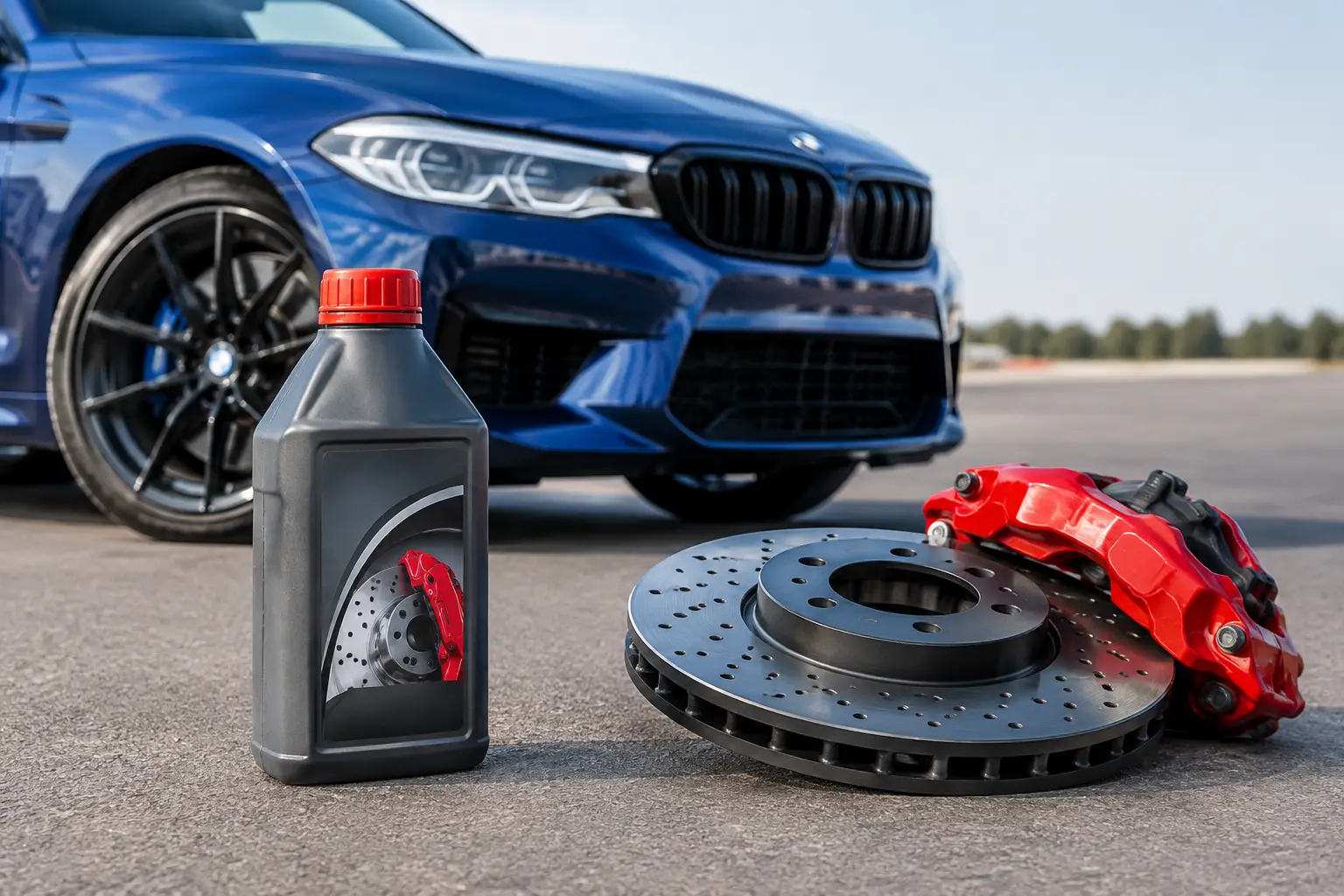
A soft pedal at the end of a hard braking zone is not usually a pad problem alone. On a BMW that sees repeated high-speed stops, old or overheated fluid can be the weak link. The best BMW brake fluid is the one that matches your car’s factory requirements, temperature demands, and maintenance habits – not simply the bottle with the biggest boiling-point number.
BMW’s late-model braking systems are sophisticated, and the right choice changes between a commuter G20 330i, a canyon-driven F87 M2, and a G8X M3 or M4 running track pads and sticky tires. Start with the specification, then choose the performance ceiling you actually need.
What Makes the Best BMW Brake Fluid?
Brake fluid transfers force from the pedal to the calipers. Because glycol-based fluid absorbs moisture over time, its boiling resistance drops as it ages. Once fluid begins to boil under heavy braking, vapor compresses where liquid does not. The result is longer pedal travel, a spongy pedal, or, in severe cases, dramatically reduced braking response.
For most modern BMW applications, the starting point is DOT 4 fluid. It offers substantially higher boiling points than conventional DOT 3 and is compatible with the seals and hydraulic components used in BMW brake systems. But DOT 4 is a broad category. A standard OEM-style DOT 4 fluid, a low-viscosity DOT 4 LV fluid, and a motorsport DOT 4 racing fluid can all carry the same basic DOT classification while serving very different use cases.
The numbers worth comparing are dry and wet boiling points. Dry boiling point refers to fresh fluid from a sealed container. Wet boiling point measures fluid after it has absorbed moisture, which is closer to real service conditions. A high dry number matters for a track car, but a strong wet boiling point and disciplined service interval matter just as much for a street-driven performance BMW.
Viscosity also matters. Many newer BMWs with advanced DSC and ABS systems specify low-viscosity brake fluid. The fluid needs to move quickly through small hydraulic passages and control valves, particularly in cold conditions. Never assume that a racing fluid is automatically the right answer simply because it posts a higher boiling point. Check the reservoir cap, owner’s manual, and the fluid manufacturer’s application data before filling the system.
Best BMW Brake Fluid by Driving Style
The correct fluid is application-specific. These are the choices that make sense for the way the car is used.
Daily-Driven BMWs and Stock Brakes
For a daily-driven BMW with stock calipers, stock-style pads, and no sustained track use, a premium OEM-spec DOT 4 or DOT 4 LV fluid is usually the right move. It supports factory ABS and DSC operation, performs well in all-season driving, and fits normal maintenance schedules.
BMW OE brake fluid or a high-quality DOT 4 LV equivalent is the conservative choice for late-model cars where factory system behavior and cold-weather response are priorities. It is not a compromise. For a 2 Series, 3 Series, 5 Series, X3, X5, or similar BMW used on the street, fresh quality fluid often delivers more confidence than an exotic racing formula left in the system too long.
Plan on a flush every two years at minimum, or sooner if the vehicle sees mountain roads, heavy towing, or frequent hard driving. Brake fluid test strips and moisture testers can help monitor condition, but time-based service remains a smart baseline.
Street Performance, Canyon Runs, and Autocross
For an M Sport or M-car that gets driven hard on back roads and sees autocross events, step up to a high-performance DOT 4 fluid. Motul RBF 600 is a proven choice in this range. It delivers substantially higher boiling resistance than typical OE fluid while remaining a practical option for enthusiasts who perform regular fluid service.
This category makes sense for cars such as the F80 M3, F82 M4, F87 M2, E9X M3, and G42 M240i that run more aggressive pads, larger tires, and repeated hard braking but are not doing long sessions in extreme heat every month. It also pairs well with a properly bedded performance pad and fresh rotors.
A better fluid will not overcome a mismatched pad compound or brakes that are already heat-soaked. If the pedal goes long only after several hard laps, inspect pad thickness, rotor condition, cooling airflow, and caliper hardware along with fluid selection.
Dedicated Track Cars and High-Heat BMW Builds
Track-focused BMWs need fluid with a serious thermal margin. Motul RBF 660 is a popular option for drivers running repeated sessions, endurance-style lapping, high-grip tires, and aggressive race pads. Its high dry boiling point gives the system more room before fluid boil becomes a concern.
Castrol React SRF is another benchmark for demanding track and competition applications. Its standout advantage is not only dry boiling performance, but also exceptionally strong wet boiling resistance. That matters for cars where fluid may stay in the system through a season, though serious track users should still flush on a schedule rather than relying on any fluid to last indefinitely.
The trade-off is cost. Premium racing fluid is more expensive, and it can be unnecessary for a street car that never puts the brakes under sustained heat. In some applications, particularly newer BMWs that specify low-viscosity fluid, compatibility requirements may outweigh the appeal of a race-focused formula. Confirm the specification before making the switch.
DOT 4 LV vs. Racing DOT 4 for BMW
This is where many brake-fluid purchases go wrong. DOT 4 LV is designed around low-temperature viscosity and fast electronic brake-control response. Racing DOT 4 is generally designed around high-temperature resistance. One is not universally better than the other.
If your BMW is a modern daily driver with integrated driver-assistance systems and occasional spirited use, the factory-specified DOT 4 LV format is often the correct choice. If it is a track-prepped M car with frequent high-temperature braking, a high-boiling racing DOT 4 may be appropriate, provided the manufacturer confirms it is suitable for the car’s hydraulic system.
Do not mix fluid types casually. DOT 3, DOT 4, and DOT 5.1 glycol-based fluids are generally chemically compatible, but mixing reduces the performance of the final blend to the lowest common denominator. DOT 5 silicone fluid is different and should not be used in BMW systems designed for glycol-based brake fluid.
How Much Brake Fluid Does a BMW Need?
A basic bleed may use around one liter, while a complete flush can require more depending on the model, procedure, and how much old fluid is displaced. Buying two one-liter bottles is often the safer move for a full performance-oriented service, especially if you are flushing a car with a complex ABS system or replacing fluid after track use.
Always use fluid from sealed containers. Once opened, brake fluid begins absorbing moisture from the air. A partially used bottle is fine for short-term use when tightly sealed and stored properly, but it is not the right choice for a critical track-day flush months later.
Bleeding BMW Brakes the Right Way
Many BMWs can be conventionally pressure-bled, but certain models and situations require additional attention. If air enters the ABS hydraulic unit, if a caliper or brake line has been replaced, or if the pedal remains inconsistent after bleeding, a scan tool may be needed to cycle the ABS pump and valves.
A pressure bleeder provides consistent results and reduces the chance of running the reservoir dry. Keep the reservoir topped up, use the correct bleed sequence for your model, and protect painted surfaces immediately if fluid spills. Brake fluid damages paint quickly.
For track cars, flush before the event if the fluid is old or has seen several heat cycles. After the event, check pedal feel and inspect the fluid color, but do not judge condition by color alone. A firm pedal is the goal, yet it does not replace scheduled service.
Choose Fluid as Part of the Whole Brake Package
Brake fluid is one part of a system. Track pads without sufficient fluid temperature capacity can create pedal fade. High-temperature fluid with worn rotors or glazed pads will not deliver consistent stops. On serious BMW builds, match the fluid to the pad, rotor, tire, driving environment, and maintenance plan.
For most owners, a premium DOT 4 LV or OE-spec DOT 4 is the best BMW brake fluid. For hard street use, Motul RBF 600 is a strong step up. For frequent track work, RBF 660 or Castrol SRF can justify their cost when matched to the vehicle and serviced correctly. If you are building a braking package for an M car or a high-output street car, EAS Store can help narrow the choice before the first bleed screw is opened.
The right bottle is the one you can trust when the next braking zone arrives faster than expected.


