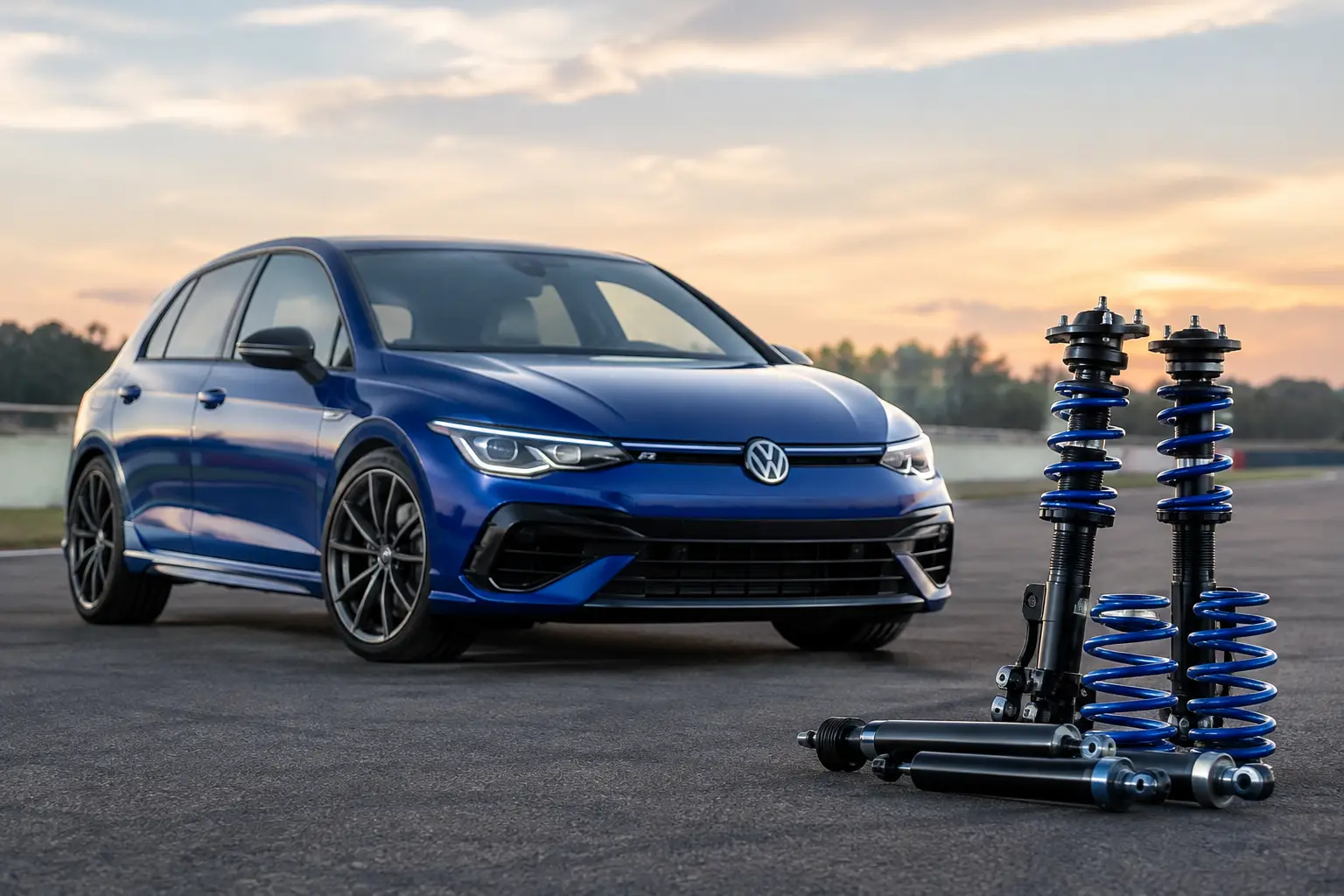
The MK8 Golf R already gives you an impressive starting point: adaptive damping, 4Motion traction, and enough factory chassis capability to make back roads genuinely entertaining. But once you add power, wider tires, or regular track use, the stock suspension calibration begins to show its compromises. This MK8 Golf R suspension guide focuses on selecting parts that work together, not simply making the car sit lower.
A good setup should add control without making the car nervous on broken pavement, tramline on the highway, or lose the usable compliance that makes the Golf R such a strong all-rounder. The right answer depends on how you drive, the wheels and tires you run, and whether retaining DCC is a priority.
Start With the Job Your Golf R Needs to Do
Before choosing springs or coilovers, be honest about the car’s real use. A daily-driven Golf R that sees spirited weekend runs needs a different setup than a car running sticky 200-treadwear tires and frequent track days. Both can benefit from suspension upgrades, but their spring rates, damper demands, ride-height targets, and alignment needs are not the same.
For a street-focused car, the objective is usually a more planted stance, reduced body movement, and sharper response while maintaining travel and ride quality. For a track-oriented build, the focus moves toward repeatable platform control under braking, cornering, and acceleration. The lower the car and the higher the grip level, the more critical geometry and damper control become.
This is why a low price or an aggressive advertised drop should never be the deciding factor. A suspension system is a chassis package. It has to work with factory electronic damping, factory bump stops, wheel fitment, tire sidewall, alignment range, and the driver’s tolerance for NVH.
MK8 Golf R Suspension Guide: Springs or Coilovers?
Lowering springs are often the right first move for an MK8 Golf R owner who likes the factory DCC behavior and wants a clean, functional improvement. A quality spring set lowers the center of gravity, reduces excess wheel gap, and increases spring rate moderately without changing every part of the system. When matched properly to the original adaptive dampers, springs retain the broad drive-mode character that makes the Golf R easy to live with.
The trade-off is fixed ride height and fixed spring-rate selection. You cannot corner-balance the car, fine-tune rake, or make meaningful damper adjustments. Springs are a sensible choice for a fast street car, especially when the factory dampers are healthy and the vehicle will not spend every month at a track event.
Coilovers make more sense when you need adjustability and a more controlled platform. A premium coilover kit can offer ride-height adjustment, matched dampers and springs, and, depending on the system, independent compression and rebound adjustment. That flexibility is valuable for drivers dialing in tire clearance, correcting stance after adding aero components, or refining behavior for a particular tire and track.
However, coilovers are not automatically better because they are more adjustable. Poorly selected or poorly adjusted coilovers can ride worse, reduce suspension travel, and create less grip on imperfect surfaces. Choose a system from an established manufacturer with spring rates and valving developed for the MQB platform, not a universal kit built around appearance.
Retaining DCC or Deleting It
DCC-equipped MK8 Golf Rs deserve special consideration. Retaining adaptive damping gives you useful range between comfort-oriented road driving and firmer spirited settings. DCC-compatible springs preserve that feature. DCC-compatible coilovers can also retain factory control functionality while replacing the physical damper assemblies with a matched performance solution.
A conventional non-DCC coilover conversion may cost less or provide a specific motorsport-oriented damper package, but it generally requires cancellation modules or coding to prevent suspension fault messages. It also removes the factory’s selectable damping behavior. There is nothing wrong with that on a dedicated track car, but it is a real compromise for a daily-driven Golf R.
Ride Height Is More Than a Visual Decision
The MK8 Golf R looks good lowered, but excessive drop is where many builds lose function. Suspension travel disappears, bump stops become active too early, and the car can skip across rough pavement rather than follow it. On track, that lack of compliance can reduce mechanical grip. On the street, it becomes tiring fast.
Moderate lowering is usually the smarter target. It improves the visual stance and reduces body movement while leaving enough bump travel for hard braking and uneven roads. The exact number varies by wheel diameter, tire size, fender shape, and coilover design, but the goal should be usable clearance and controlled movement, not the lowest possible fender gap.
Pay attention to wheel and tire fitment at the same time. A wider wheel, lower offset, or taller tire can rub even at a ride height that worked with the factory wheels. Compression clearance must be checked at full steering lock and through suspension travel, not only while the car is parked.
Do Not Skip Alignment and Supporting Hardware
Alignment is where a new suspension package becomes a real handling upgrade. Lowering changes camber and toe, and those changes affect turn-in, tire wear, straight-line stability, and braking confidence. An alignment performed to generic factory numbers may be acceptable for commuting, but it may not suit a lowered car on performance tires.
For a street setup, moderate negative front camber improves front-end bite without destroying inner shoulder wear, provided toe is kept conservative. Track-driven cars often need more negative front camber to protect the outer tire shoulder during sustained cornering. The correct figure depends on tire compound, tire temperature behavior, driving style, and how many highway miles the car sees.
Toe deserves equal attention. Too much toe-out can make the car eager to turn but unstable at speed. Excessive toe-in can dull response and accelerate tire wear. A precise alignment from a shop familiar with performance European vehicles is money well spent after any meaningful ride-height change.
Consider the supporting components as well. Adjustable front top mounts or camber plates can provide the camber range needed for track use. Upgraded strut mounts, bearings, and hardware are worthwhile when replacing dampers, particularly on cars with significant mileage. Rear adjustable arms can help restore alignment range on more aggressively lowered builds.
Sway Bars: Useful, but Not a Substitute for Dampers
Sway bars can sharpen the Golf R’s balance, but they should be chosen after the primary spring and damper decision. A rear sway bar is popular because it can reduce understeer and help the car rotate on corner entry. Set too stiff, though, it can make the rear axle abrupt over mid-corner bumps or reduce confidence in wet conditions.
An adjustable bar gives you tuning range, which is valuable if the car’s use evolves. Start at the softer setting and evaluate the car before moving stiffer. Front sway bar changes are more involved and should be made with a clear balance objective, not because a bigger bar sounds like an automatic upgrade.
Match the Setup to Power, Tires, and Brakes
Suspension choices become more important as the rest of the build progresses. A tuned MK8 Golf R with upgraded cooling, intake, exhaust, and fueling can accelerate hard enough to expose wheel hop, squat, and inconsistent traction. Better dampers and appropriate spring rates help the chassis use available grip more effectively, but they cannot compensate for worn tires or poor alignment.
Tires are the final connection between every suspension decision and the road. A high-performance summer tire can transform steering precision and braking feel, while a track tire may require more camber and a more disciplined setup to avoid rapid shoulder wear. If you are investing in coilovers and alignment hardware, budget for tires that can show the benefit.
Brake upgrades also change how the car feels under load. More capable pads, fluid, rotors, or a larger brake package can encourage later braking and higher entry speeds. That puts more demand on front-end support and damping control. Build the chassis as a system rather than buying parts in isolation.
A Smart Order for Building the Chassis
For most owners, start with tires and a baseline alignment. Then choose springs or coilovers based on actual use, install fresh supporting hardware where needed, and complete a performance-focused alignment. Add sway bars or adjustable mounts only when you have identified a specific handling limitation.
That sequence avoids a common problem: installing several parts at once and having no idea which one improved or hurt the car’s behavior. It also keeps the budget focused on components that deliver measurable control rather than cosmetic changes alone.
The best MK8 Golf R suspension setup is the one that makes you drive the car harder with more confidence, not the one that creates the lowest ride height in a parking lot. If you need help matching DCC-compatible springs, premium coilovers, mounts, and chassis hardware to your exact build, EAS Store can help narrow the options before you order.