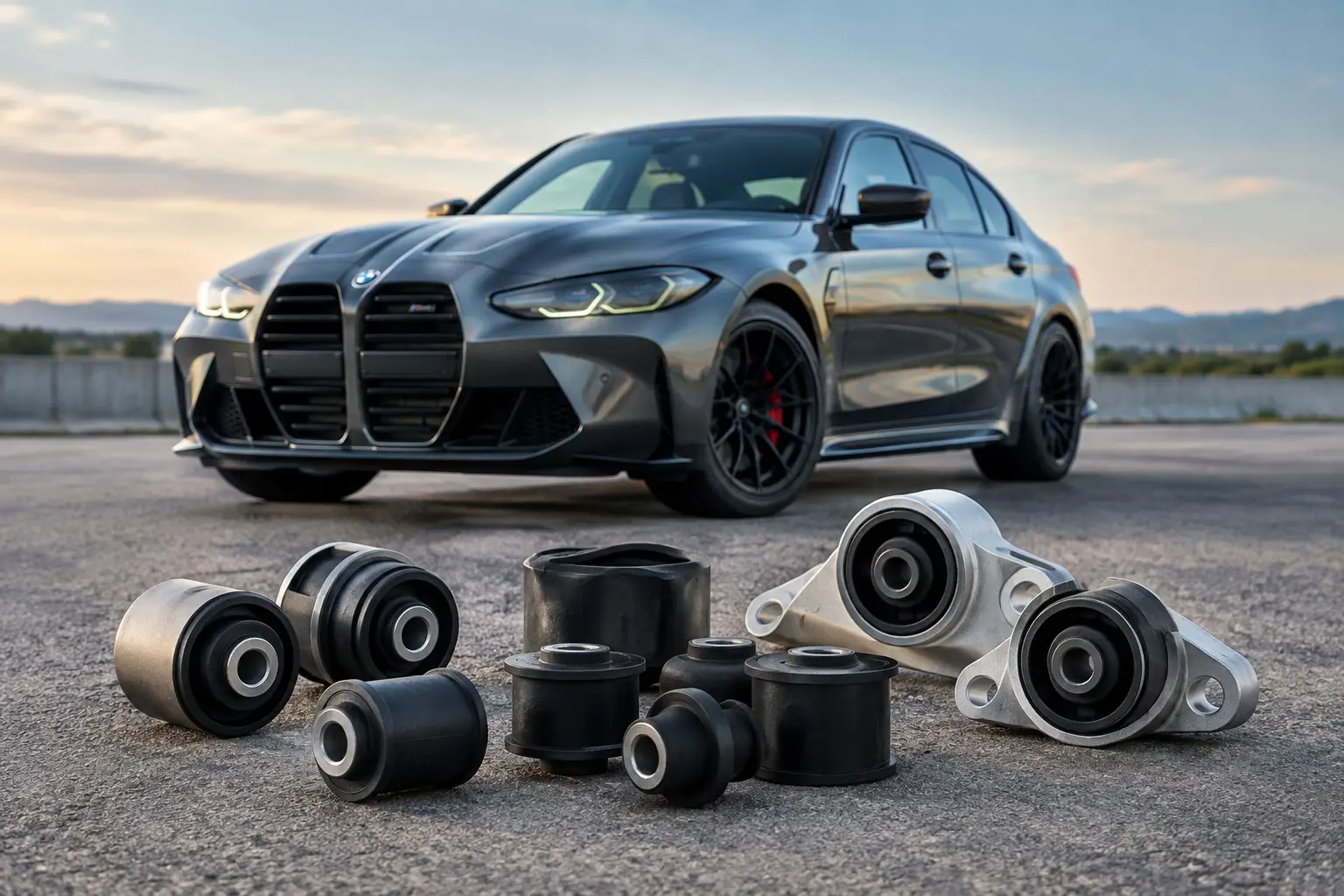
The best BMW G80 suspension bushings are not automatically the hardest parts available. On an S58-powered M3, the right choice depends on where the car loses precision, how much street mileage it sees, tire compound, power level, and how much added noise or vibration the driver will accept. A well-chosen bushing upgrade can make the G80 feel more tied down under braking, cleaner at turn-in, and more predictable when power is applied at corner exit. The wrong one can make an otherwise refined M3 feel unnecessarily harsh.
The G80 already starts with an exceptionally capable chassis. That is exactly why selective upgrades work better than replacing every compliant component with a solid mount. Focus on the locations that move under the highest loads, then match the material to the car’s actual use.
What Makes the Best BMW G80 Suspension Bushings?
Bushings control the movement between suspension components and the chassis. Factory rubber isolates noise and allows a measured amount of compliance. That compliance helps ride quality on broken pavement, but it can also allow alignment angles to change under braking, cornering, and acceleration.
On a G80 M3, this often appears as a slight delay between steering input and chassis response, instability when heavily loaded in a braking zone, or a rear end that feels less settled once torque comes in. Those traits can become more noticeable with sticky 200-treadwear tires, track alignment settings, coilovers, or increased S58 output.
The best upgrades reduce unwanted movement without introducing a larger compromise somewhere else. Material matters, but design and fitment matter just as much. A properly engineered rubber upgrade can outperform a poorly designed polyurethane bushing, while a quality spherical bearing may be ideal for a track car and completely wrong for a daily commuter.
Rubber, Polyurethane, and Spherical Bearings
Higher-durometer rubber is the closest fit for a street-driven G80. It maintains much of the factory isolation while resisting deflection better than the original part. This is a strong route for owners who want OEM-like behavior with more control during spirited driving.
Polyurethane bushings generally offer a noticeable step up in stiffness and can be a practical choice in some mounting locations. They are not all the same. Quality polyurethane parts use the correct hardness, internal sleeves, lubrication provisions, and geometry for the application. Poorly designed versions can bind, squeak, or transmit more vibration than expected. They also may not be the best choice where a suspension arm needs multi-axis articulation.
Spherical bearings, often called monoballs or solid bearings, provide the most direct location of a suspension arm. They remove the elastic movement found in rubber and polyurethane, preserving alignment far more consistently under load. The trade-off is clear: more road texture, more mechanical feedback, and potentially faster service requirements in harsh weather or high-mileage use. For a G80 used primarily for track days, time attack, or competition, that precision is often worth it.
Start With the Bushings That Change the Car Most
A full bushing overhaul is rarely the first move on a newer G80. Targeting the high-impact areas produces a more balanced result and keeps the budget focused on parts the driver will actually feel.
Front Tension Strut Bushings for Braking and Turn-In
The front tension strut is one of the most valuable places to reduce compliance. During hard braking, its bushing sees substantial fore-aft load. A firmer rubber mount or spherical upgrade helps the front tires hold their intended position rather than shifting rearward under load.
The benefit is not just a firmer brake pedal sensation. The car tracks more confidently into a corner, steering response becomes more immediate, and the front end can feel more consistent during trail braking. For a street and occasional track G80, upgraded rubber or a street-focused sealed bearing solution is usually the smart middle ground. A dedicated track car can justify a true monoball setup.
Rear Toe and Control Arm Bushings for Stability
The G80’s five-link rear suspension gives BMW extensive control over wheel movement, but it also means multiple joints and bushings influence how the rear tire behaves under load. Rear toe-control locations deserve close attention because unwanted movement here can alter rear toe during acceleration and cornering.
Spherical bearings or complete performance rear links are often the preferred solution for drivers running aggressive track tires and alignment settings. They deliver a more stable, repeatable rear axle feel. On the street, however, the added feedback can be substantial. If the car sees frequent commuting, a selective rear upgrade is usually better than converting every rear suspension joint at once.
Rear control arm bushings can also improve power-down behavior, especially on cars with upgraded turbos, ethanol blends, or other modifications that raise torque well beyond factory levels. The goal is controlled geometry, not simply maximum stiffness. A rear axle that cannot articulate correctly can lose grip over uneven pavement.
Differential Mounts Are Worth Considering
Differential mounts are not technically suspension bushings, but they belong in the same chassis conversation. The G80’s rear differential experiences serious load changes during throttle transitions, launches, and aggressive upshifts. Firmer differential bushings reduce differential movement, improving driveline response and helping the rear of the car feel more connected when torque comes in.
This is a particularly sensible upgrade on higher-output S58 builds. Expect some increase in drivetrain presence inside the cabin, especially at low rpm or during cold operation. The amount depends heavily on mount material and design. A street-performance mount can tighten the car without making it feel like a race car. A solid mount is a different commitment.
Match the Bushing Package to Your G80 Build
For a daily-driven M3 on performance street tires, start conservatively. Front tension strut bushings and carefully selected differential mounts offer meaningful gains without turning normal roads into a constant source of vibration. If the car is lowered, prioritize an alignment afterward and inspect the rest of the suspension for worn or stressed components.
For a street car that attends several track days each year, front monoballs or high-quality performance bushings are often the first major chassis upgrade. Add rear toe-control bearings or performance links if the driver wants more consistency at the limit. This combination addresses the areas most likely to affect braking confidence, steering precision, and rear-end stability without committing the entire car to race-car NVH.
For a dedicated track G80, spherical bearings and solid-mounted components make more sense. Consistent alignment under high lateral load matters more than cabin refinement in this application. This type of build should be treated as a system: quality dampers, corner balancing, alignment, tire selection, and regular inspections are all part of getting the value from rigid bushing choices.
Do Not Buy Bushings Before Checking Fitment
G80 M3, G82 M4, and G83 M4 Convertible parts frequently overlap, but buyers should never assume every component fits every chassis or production range. Verify the exact model, drivetrain configuration, model year, and whether the part is designed for the factory arm or requires a complete replacement arm.
Also check whether a bushing is supplied as a pressed-in component, an insert, a complete housing, or part of an upgraded arm. Press-in bushings often require a hydraulic press and the correct fixtures. Installing one incorrectly can damage the new bushing, distort an aluminum arm, or create preload that shortens service life.
Any significant suspension bushing work should be followed by a professional alignment. Ride-height-sensitive arms must be tightened at their loaded position, not with the suspension hanging at full droop. Skipping that detail can preload a rubber bushing and cause premature failure.
A Better Upgrade Order Than a Full Kit
If budget or comfort matters, build the chassis in stages rather than ordering the stiffest complete kit. A practical order is:
- Front tension strut bushings or monoballs for clearer braking and turn-in
- Differential mounts for improved throttle response and driveline control
- Rear toe-control upgrades for repeatable rear geometry on track
- Additional rear arm bearings only when the car’s use and tire package justify them
This approach makes it easier to evaluate each change. It also avoids stacking multiple sources of NVH and then struggling to identify which component created an unwanted noise or vibration.
The right G80 suspension bushing setup should make the M3 feel more accurate, not simply more severe. Choose the parts that support your tire, alignment, power, and driving goals, then install them with the same care you would give any serious performance upgrade. For buyers comparing fitment-sensitive G8X components, EAS Store can help narrow the options to a package that matches the way the car is actually driven.