A tuned MQB car can expose its factory brake limits quickly. Add sticky tires, higher trap speeds, or repeated mountain and track use, and the best MQB brake upgrades become less about a bigger caliper behind the wheel and more about building a system that stays consistent when the pedal is hot.
For a Golf GTI, Golf R, Audi S3, or RS3, the right answer depends on chassis, model year, wheel diameter, power level, and how the car is actually driven. A street car that sees occasional spirited runs needs something different from a high-output build making repeated laps at a road course. Buy for the problem you have, not for the largest rotor that fits.
Start With the Real Limitation
Brake performance is often mistaken for pure stopping distance. On a single cold stop, a factory MQB brake system can be remarkably capable, especially with quality tires. The trouble begins when heat builds. A long downhill road, several hard highway pulls, or a 20-minute track session can push factory pads and fluid beyond their intended operating range.
The symptoms are familiar: a soft pedal, a longer pedal travel, fading bite, vibration after hard use, or the sharp smell of overheated pad material. Each points to a different weak link. A firmer pedal may require fluid and proper bleeding. Fade may call for a higher-temperature pad compound. Cracking rotors, uneven deposits, or recurring overheating can justify more rotor mass, better airflow, or a complete front brake kit.
That diagnosis matters because a big brake kit will not fix contaminated fluid, poor pad bedding, or tires that cannot generate enough grip to use the added braking capacity.
The Best MQB Brake Upgrades Start With Pads and Fluid
For most street-driven MQB vehicles, pads and fluid are the highest-value first move. They improve confidence without adding major cost, weight, or fitment concerns.
Choose Pads for Temperature, Not Marketing
A performance street pad gives stronger initial bite and greater heat tolerance than many original-equipment compounds. It is a good choice for a daily-driven GTI or S3 with a tune, upgraded tires, and aggressive weekend use. Expect some compromise: more dust, more rotor wear, and occasionally more noise than an OEM pad.
Track-focused pads tolerate much more heat and remain stable during repeated heavy braking. They are the correct direction for drivers who regularly attend track days, but they are not always pleasant for commuting. Cold bite can be reduced, noise can be substantial, and dust is typically aggressive. Many serious drivers run one pad set for street use and a dedicated track compound for events.
Do not assume the most aggressive compound is automatically the best. A pad that never reaches its effective temperature range can feel worse than a properly selected street-performance pad. Match the compound to vehicle weight, tire grip, speed, and session length.
High-Temperature Fluid Is Cheap Insurance
Brake fluid absorbs moisture over time, which lowers its boiling point. Once fluid boils, compressible vapor enters the hydraulic system and pedal feel can disappear when it matters most. Fresh high-temperature fluid is essential before track use and worthwhile on any hard-driven MQB platform.
A quality DOT 4 racing or high-performance fluid generally provides the temperature margin enthusiasts need. The right service interval depends on use. A lightly driven street car may need periodic replacement based on age and moisture condition, while a track car should receive fresh fluid much more often. A pressure bleeder and careful procedure matter as much as the fluid itself.
Stainless-steel braided brake lines can improve pedal consistency by reducing line expansion, but they are a supporting upgrade, not a cure for overheating pads or boiling fluid. Use approved, vehicle-specific lines and inspect them as part of normal brake service.
When Rotors Make Sense
Rotors are heat sinks. More mass and better internal vane design can absorb and shed more energy before temperatures become excessive. For a tuned Golf R, S3, or GTI on performance tires, quality blank or slotted rotors paired with the correct pad compound can be an effective middle ground.
Slotted rotors can help keep the pad face clean and provide a useful visual wear indicator. They may also accelerate pad wear slightly. Drilled rotors can look excellent and can be appropriate in certain engineered applications, but repeated high-temperature track use places more stress around drilled holes. For sustained lapping, many experienced drivers prefer high-quality blank or slotted rotors designed for thermal durability.
Avoid treating two-piece rotors as a cosmetic purchase. Their advantages can include lower unsprung mass, replaceable friction rings, and improved heat management, but they are most valuable when the car’s use and budget justify them. On a mostly street-driven car, premium one-piece rotors may be the more sensible investment.
Best MQB Brake Upgrades for Frequent Track Use
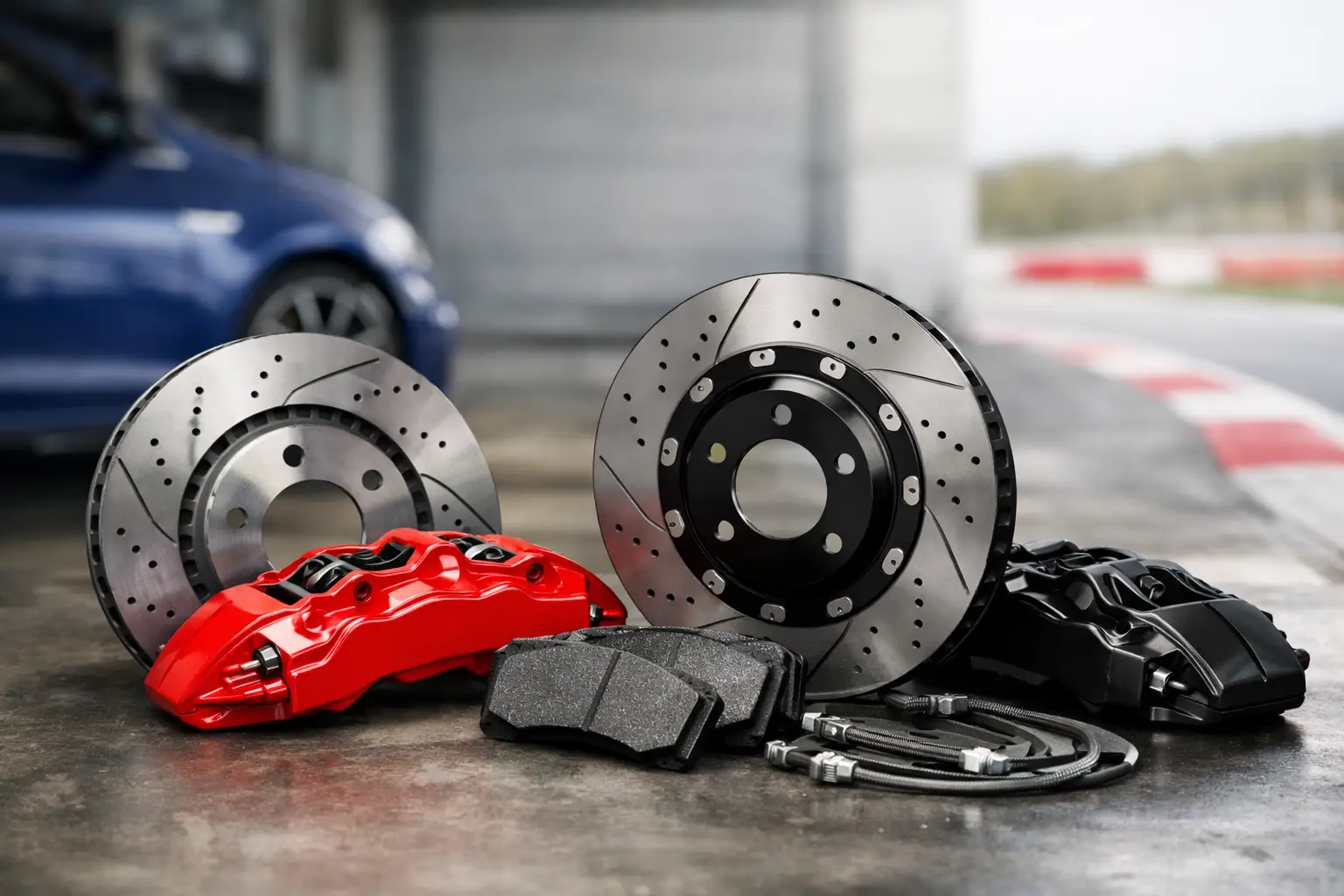
Once pads, fluid, and rotors are no longer enough, a properly engineered big brake kit becomes a serious upgrade. The goal is not merely more pistons. A good kit increases thermal capacity, uses a rigid caliper, provides a pad shape with more usable volume, and is engineered around rotor size, caliper position, brake balance, and wheel clearance.
Front Big Brake Kits Deliver the Biggest Change
The front axle does most of the braking work under hard deceleration. That is why a front big brake kit is usually the first major hardware upgrade for track-focused MQB builds. Larger rotors add leverage and heat capacity, while fixed multi-piston calipers can improve clamping consistency and pedal response.
For high-horsepower Golf R, S3, and RS3 applications, this additional thermal headroom can prevent the recurring fade and consumable wear that factory-sized systems may show under repeated use. It also gives drivers access to motorsport-style pad shapes, often with a broader selection of compounds for different track conditions.
Wheel clearance is non-negotiable. Rotor diameter alone does not determine fitment. Caliper profile, spoke shape, barrel clearance, wheel offset, and balancing weights all matter. A kit that clears one 18-inch wheel may not clear another 18-inch design. Confirm fitment against the exact wheel before ordering, especially with aftermarket forged wheels or winter setups.
Do Not Ignore the Rear Axle
Rear upgrades are more application-dependent. On many MQB cars, the rear system is not the first thermal bottleneck. A rear big brake kit can improve appearance, reduce weight, and support a fully matched track setup, but it should not be selected without considering electronic parking brake compatibility, rotor hat offset, and overall brake bias.
Brake balance is critical. Oversizing the rear system without proper engineering can upset stability under threshold braking. The best setups are designed as systems, not assembled from unrelated parts because they share a bolt pattern.
Tires, Cooling, and Brake Setup Matter More Than Most Builds Expect
A brake upgrade is only as effective as the tire contact patch. High-grip 200-treadwear tires can dramatically increase braking force, but they also put more heat into the brake system because the car can decelerate harder. If you add serious tire, reassess pads, fluid, and rotor temperatures at the same time.
Brake cooling is one of the smartest upgrades for a dedicated track car. Proper ducting directs air toward the rotor center or inner vane area, where it can travel through the rotor and carry heat away. It can extend pad and rotor life while reducing fade. The design needs to be secure, protected from suspension travel, and appropriate for the vehicle’s underbody layout.
Proper bedding is equally important. New pads and rotors need a controlled transfer layer of pad material on the rotor face. Skipping the manufacturer’s bedding procedure can create uneven deposits that feel like warped rotors. In many cases, the rotor is not actually warped – it has inconsistent friction material on its surface.
Build by Use Case, Not by Spec Sheet
For a fast daily driver, start with a performance street pad, fresh high-boiling-point fluid, and quality rotors when replacement time comes. This combination preserves civilized street behavior while providing a substantial margin over stock.
For an occasional track-day car, add track-capable pads, stainless lines if desired, and a disciplined maintenance schedule. Keep a dedicated track pad set if street noise and dust are unacceptable. Monitor pad thickness carefully, because heavy vehicles and high-speed tracks consume front pads quickly.
For a dedicated circuit build or a high-output MQB car that repeatedly reaches high speeds, invest in a proven front big brake kit, correct pad compounds, cooling, and wheels confirmed to clear the system. This is where premium components pay for themselves through repeatable braking, less heat stress, and reduced downtime between sessions.
Compatibility should always be confirmed by exact chassis and model year. MQB covers a broad family of vehicles, and factory brake packages can vary even between closely related trims. EAS Store can help narrow the correct configuration when wheel fitment, brake package, and intended use need a second set of experienced eyes.
The best upgrade is the one that lets you brake hard at the end of the session with the same confidence you had at the beginning. Start where the system is failing, choose parts that work together, and leave enough budget for fresh fluid, proper installation, and the tires that make every braking upgrade count.