A stock G8X can make a hard street pull without drama, then show its real thermal limits after several hot laps, repeated roll races, or back-to-back dyno pulls. That difference is why a proper bmw s58 cooling system guide starts with how the car is used, not a generic list of parts. The S58 is a highly capable twin-turbo platform, but higher boost, ethanol blends, upgraded turbos, and sustained load all add heat that must go somewhere.
For a lightly tuned street car, the factory cooling package is often more capable than the internet gives it credit for. For a 700-whp build that sees summer drag-strip passes, mountain roads, or road-course sessions, the system needs to be viewed as a complete thermal strategy. Buying the largest available heat exchanger without understanding the rest of the circuit can leave power on the table and create new fitment or warm-up compromises.
How the S58 Manages Heat
The S58 does not rely on one radiator doing every job. Its cooling architecture is divided into multiple circuits and heat exchangers, each handling a different source of temperature. Engine coolant controls cylinder-head, block, and turbocharger-related heat. The charge-cooling circuit removes heat from compressed intake air through the water-to-air intercooler system. Oil cooling plays its own critical role by stabilizing lubricant temperature under sustained load.
That distinction matters because a high intake-air temperature problem is not automatically an engine-coolant problem. Likewise, lowering charge-air temperatures will not necessarily solve elevated oil temperatures on a long road-course session. The best upgrade path identifies the temperature that is actually limiting the car.
On modified S58 cars, heat generally shows up in three ways: intake-air temperatures climb through repeated pulls, engine coolant temperatures rise during long high-load operation, or oil temperature remains elevated after the engine has been worked hard. Sometimes all three increase together, but they should still be diagnosed independently through reliable logging.
BMW S58 Cooling System Guide: Start With Data
Before selecting parts, log the car in the conditions that matter to you. A brief third-gear street pull does not reveal the same weaknesses as a 20-minute track session. Use your preferred BMW-capable logging solution to watch intake-air temperature, coolant temperature, oil temperature, ambient temperature, boost pressure, ignition correction, and power reduction behavior where available.
Pay attention to temperature recovery, not only peak numbers. A charge-cooling system that rises moderately during one pull but quickly returns near baseline may be perfectly suitable for spirited street driving. A system that heat-soaks after two consecutive pulls will be far more noticeable on a tuned car, especially where timing and boost targets are calibrated around consistent air temperatures.
Also look for patterns. If temperatures rise only in traffic, inspect airflow and fan operation. If they rise at speed on track, the car may need more heat-exchanger capacity, better airflow management, or a less restrictive cooling path. If the issue appears after a power increase, confirm the tune, fuel quality, and commanded boost are appropriate before assuming hardware alone is the answer.
The Charge-Cooling Circuit Is Usually the First Upgrade
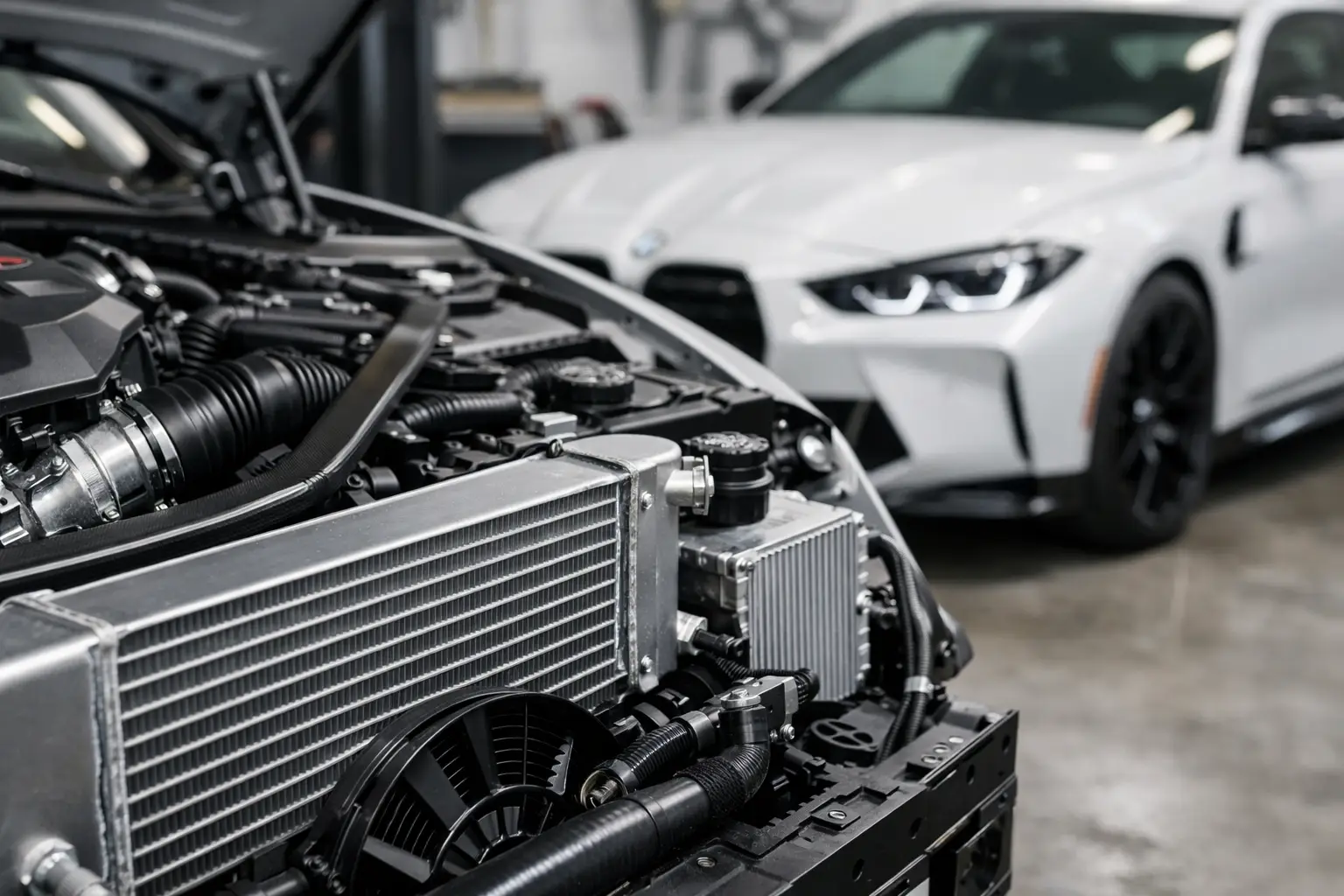
The factory S58 uses a water-to-air charge-cooling arrangement, making the low-temperature circuit a major focus for G80 M3, G82 M4, and G83 M4 owners pursuing consistent performance. As turbocharger outlet temperatures rise, the intercooler core transfers more heat into coolant. That coolant then needs sufficient volume, efficient heat exchange, and clean airflow to shed heat before the next hard pull.
An upgraded front heat exchanger is often the most logical first step for a tuned street or drag-oriented car. A quality larger-core unit increases the system’s ability to reject heat, helping control intake-air-temperature climb during repeated acceleration. This is especially useful on ethanol-blend calibrations and upgraded-turbo combinations, where airflow and boost pressure can push the stock system beyond its comfortable recovery range.
A higher-capacity heat exchanger is not a magic fix. Core thickness, fin design, flow path, end-tank construction, and ducting all matter. An oversized core that receives poor airflow or creates excessive restriction is not automatically superior. Premium application-specific systems are engineered around the G8X chassis, factory mounting points, and surrounding airflow rather than simply chasing the largest dimensions.
For cars that see frequent drag-strip use or repeated street pulls, an upgraded coolant reservoir can also be valuable. More fluid volume gives the low-temperature circuit more thermal buffer, which can slow temperature rise between runs. It does not replace heat-exchanger capacity, but it can complement it well when the car has limited cool-down time.
Engine Coolant, Radiators, and Sustained Load
The engine cooling circuit deserves more attention as power and track time increase. A street-driven Stage 1 or Stage 2 S58 may not require radiator changes if logs remain controlled. But a high-output build operated in hot climates, at high ambient temperatures, or in extended road-course sessions can benefit from increased radiator capacity and more efficient airflow through the cooling stack.
Radiator upgrades make the most sense when engine coolant temperature trends upward under sustained load rather than spiking briefly after a single pull. This is common on cars with high power, aggressive track use, or reduced airflow caused by packed debris, damaged fins, aftermarket bodywork, or improperly fitted duct panels.
Do not overlook the basics during installation. Coolant level, proper bleeding procedures, intact seals, clean heat-exchanger fins, and undamaged connectors matter. Modern BMW cooling systems are electronically managed and can be sensitive to trapped air or an installation shortcut. A premium part installed incorrectly will not deliver premium results.
Oil Temperature Is a Separate Decision
Oil is both a lubricant and a heat carrier in a hard-driven S58. High oil temperatures can thin the lubricant beyond the range intended for the chosen oil grade, accelerate degradation, and contribute to power reduction during extended sessions. For serious track cars, oil temperature deserves the same logging discipline as intake-air and coolant temperature.
An upgraded oil cooler is most relevant when oil temperature remains high after the engine coolant and charge-cooling systems have been addressed. It is not always necessary for a weekend street car, even one with a healthy tune. On the other hand, a car making repeated 20-minute sessions in 90-degree weather has very different requirements from a car that only sees occasional highway pulls.
Oil cooler selection should consider thermostat strategy, line routing, pressure drop, mounting location, and protection from road debris. More cooling is not automatically better if the system struggles to bring oil up to operating temperature during normal driving. The target is stable operating temperature under demand, not the lowest number possible.
Airflow Is the Part Most Builds Miss
Cooling hardware only works when air moves through it efficiently. The G8X front end contains a dense stack of heat exchangers, and airflow can be disrupted by debris, bent fins, poor duct sealing, nonfunctional active grille components, or aftermarket parts that block exit paths.
When upgrading a heat exchanger or radiator, inspect the full path from the bumper opening through the core and out of the engine bay. Factory shrouds and seals are not cosmetic pieces. They direct pressure through the heat exchanger instead of allowing air to escape around it. Retaining or improving that control can make a meaningful difference at speed.
This is also why cooling modifications should be selected as a package for the car’s goal. A 600-whp daily driver may need only a strong charge-cooling upgrade and disciplined maintenance. An 800-whp ethanol car with upgraded turbos may need a heat exchanger, reservoir, improved engine cooling, and a close look at oil temperatures. A dedicated track build may require all of that plus brake cooling and careful airflow management across the entire front end.
Build the System Around Your Use Case
There is no single best S58 cooling setup. The right configuration depends on horsepower, fuel, climate, driving duration, and recovery time between pulls. Installing parts in stages is often the smart approach: establish a baseline, solve the limiting circuit, then validate the result with fresh logs.
Choose application-specific components from manufacturers with proven G8X fitment, quality core construction, and clear installation support. EAS Store can help match cooling hardware to the exact demands of your S58 build, whether the priority is consistent street performance, drag-strip recovery, or lap-after-lap stability.
Treat cooling as protection for the power you already paid to make. When temperatures stay controlled, the S58 can deliver more consistent boost, timing, and confidence exactly when the car is being driven as intended.