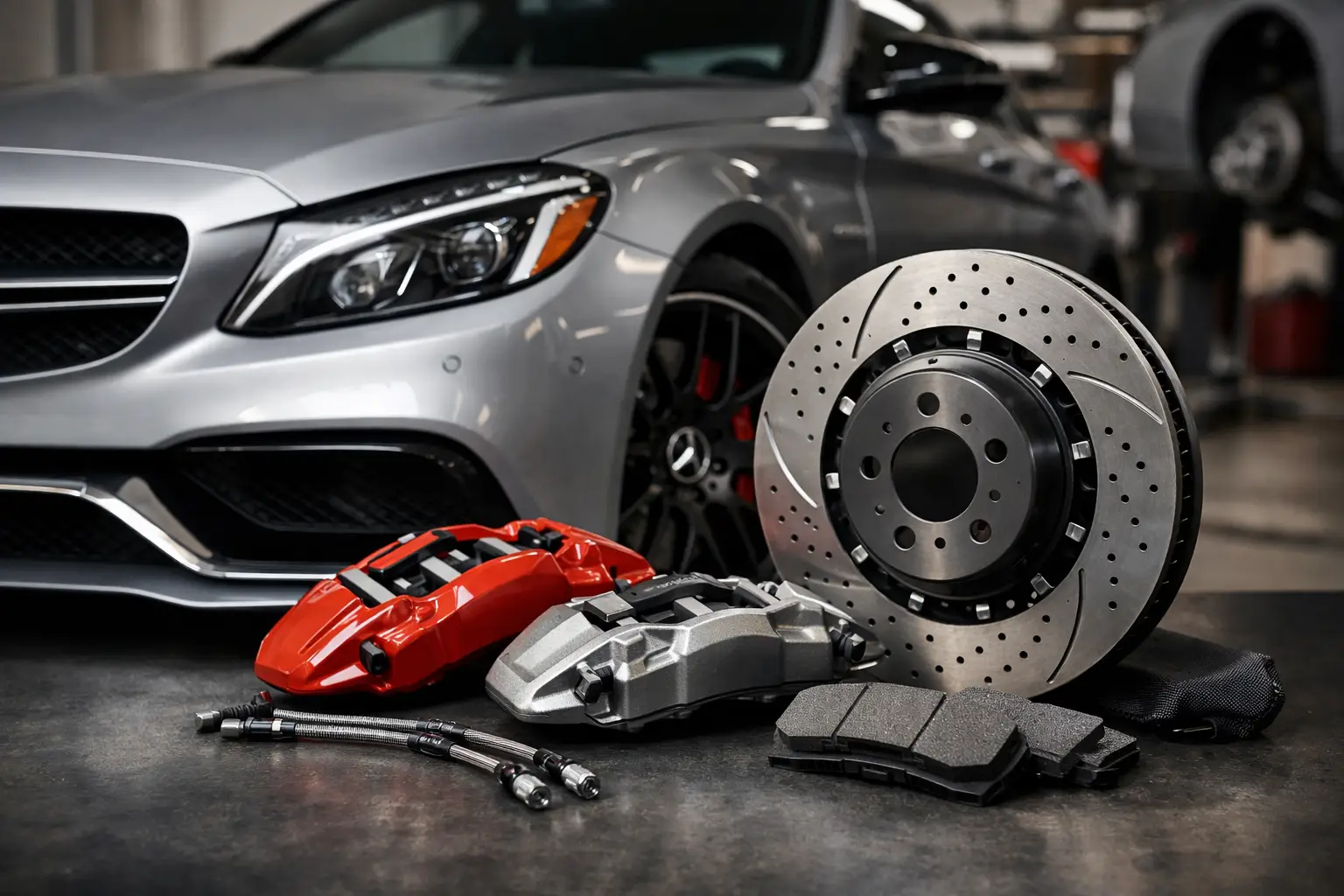
A fast street car can make a track pad feel impressive for one hard stop, then miserable for every commute afterward. That is the real decision behind street pads versus track pads: not which compound has the most aggressive marketing, but which one operates correctly at the temperatures your car actually sees.
For an Audi RS3, BMW M3/M4, Golf R, or Mercedes-AMG, brake pad choice affects more than stopping distance. It changes pedal consistency, rotor wear, wheel dust, cold response, noise, and how confidently you can drive when the brakes are repeatedly loaded. The right answer depends on vehicle weight, power level, tire grip, brake hardware, and whether your car spends its weekends at autocross, track days, or simply carving back roads.
Street Pads Versus Track Pads: The Core Difference
The difference is heat. Brake pads create friction by converting vehicle speed into heat, and every pad compound is engineered to work best within a particular temperature range.
A street-oriented performance pad is designed to deliver predictable bite from cold and through normal road temperatures. It needs to work when you pull out of the garage on a 35-degree morning, sit in traffic, and make an emergency stop after a short drive. It should also control noise and dust well enough that driving the car remains enjoyable.
A true track pad is built for repeated high-energy braking at much higher temperatures. It is meant to survive hard braking from triple-digit speeds, lap after lap, without the compound smearing, fading, or changing pedal feel. That temperature capacity comes with compromises: many track pads have weak cold bite, produce substantial dust, squeal loudly, and can be hard on rotors when used outside their intended environment.
The common mistake is assuming a track compound is automatically better because it is more aggressive. On the street, a pad that is below its operating temperature can stop less consistently than a quality street performance pad. More friction at race temperature does not help much when the brakes are cold at the end of your driveway.
What a Street Performance Pad Does Well
Street performance pads are the correct choice for most modified daily-driven European cars, including vehicles with upgraded turbochargers, ethanol fueling, or higher-output calibrations. More horsepower raises the demand on the brakes, but it does not automatically mean the car needs a dedicated race compound.
A quality street pad typically offers a strong initial bite, stable pedal feel for spirited road driving, and a usable temperature ceiling for occasional hard braking. Compared with an OEM pad, the right upgrade can reduce fade during mountain driving, improve confidence under repeated stops, and better match the capability of upgraded tires.
The practical benefits matter every day. Street compounds are generally quieter, create less abrasive dust, and are more compatible with factory-style rotors. They also bed in more easily and recover well after normal commuting. For owners who care about clean wheels, low-speed refinement, and predictable response in changing weather, these traits are not minor details.
That does not mean every street performance pad is the same. Some are tuned toward comfort and low dust, while others lean toward higher friction and occasional track use. A pad marketed for spirited street driving may tolerate an autocross event or a novice track session, but it should not be expected to handle repeated 20-minute sessions on a fast road course in a heavy, high-horsepower car.
Best fit for street-focused builds
A street performance compound is usually the right fit for a daily-driven MQB car, a tuned B58 BMW, or an RS-model Audi that sees spirited road use and occasional short-duration events. It is also the smarter choice for drivers who want to retain confident cold braking, civilized noise levels, and reasonable rotor life.
If your factory brakes are reaching their limits on the street, inspect the full system before jumping directly to a track pad. Fresh high-temperature brake fluid, correct pad bedding, healthy rotors, stainless lines where appropriate, and better tires can make a substantial difference.
What Makes a Track Pad Different
Track pads are designed around sustained thermal load. During a track session, a 3,500-pound car can repeatedly shed enormous speed in a few seconds. The pad must maintain friction while the rotor, caliper, and backing plate temperatures climb far beyond normal road conditions.
A proper track compound resists fade and maintains a more consistent coefficient of friction at those temperatures. It is also formulated to reduce pad material transfer problems under severe braking. This stability lets an experienced driver brake harder and more predictably deep into a session, assuming the rest of the brake system is prepared for the job.
But a track pad is part of a track brake package, not a stand-alone solution. High-boiling-point fluid is essential. Rotors need to be within specification and free of cracks. Caliper seals, dust boots, cooling airflow, tire grip, alignment, and driver technique all influence brake performance. On high-output G8X, RS3/TTRS, and other heavy performance platforms, brake cooling and fluid management can be just as important as compound selection.
Track pads may also create more rotor wear because of their abrasive nature and the temperatures involved. Some compounds should be paired with specific rotor types or may require dedicated track rotors to avoid cross-contaminating pad transfer layers. Mixing compounds on the same used rotor without proper preparation can lead to vibration, uneven deposits, and inconsistent braking.
Best fit for dedicated track use
Choose a true track pad when your car sees regular road-course use, you are reaching the thermal limit of street compounds, and you are prepared to accept noise, dust, wear, and reduced cold manners. This is especially relevant for advanced drivers running sticky 200-treadwear tires, aggressive lap times, or repeated sessions in hot conditions.
For many enthusiasts, a second set of pads and rotors is the most effective setup. Keep a refined street compound on the car for regular driving, then install track pads before an event. This approach protects street drivability while giving the track setup the temperature capacity it needs.
The Middle Ground: Dual-Duty Pads
Dual-duty pads exist because many performance-car owners want one setup that can handle commutes and occasional track days. These compounds are typically more temperature-tolerant than a conventional street pad, with better fade resistance and firmer high-speed braking behavior. They can be a strong option for a driver attending a few events per year.
The trade-off is that dual-duty pads are rarely the best at either extreme. They may dust more, squeal at low speeds, and wear rotors faster than a street-oriented compound. At the same time, they may still fall short during long sessions on a fast circuit, particularly on a heavy car with significant power.
Be honest about what occasional track use means. One beginner event with cooldown laps is different from six sessions at Circuit of the Americas in summer heat. A dual-duty compound can be a sensible compromise for the first scenario. The second calls for dedicated track pads, fluid, and likely additional cooling strategy.
Choose by Vehicle Use, Not by Badge
An M car, RS model, AMG, or heavily modified Volkswagen deserves capable brakes, but the badge alone does not select the pad. A stock Golf R driven aggressively on mountain roads may be better served by a high-quality street performance compound than a full race pad. A 700-horsepower RS3 on track-focused tires may need a dedicated track setup even if it retains factory calipers.
Start with four questions: How often does the car see track time? How long are the sessions? What tires are fitted? Are you experiencing actual fade, or simply looking for a firmer, more confidence-inspiring pedal? Your answers narrow the field quickly.
Also consider the axle balance. Front pads handle most braking load, but rear compound selection still matters for stability and ABS behavior. Do not mix random friction levels front to rear based solely on what is available. Use a matched application recommendation designed for your chassis and braking system.
Installation and Bedding Still Matter
Even the correct compound can perform poorly if it is installed on worn rotors, bedded incorrectly, or paired with old fluid. Bedding establishes an even transfer layer of pad material on the rotor face. Skipping it can cause vibration, uneven bite, and premature wear that gets blamed on the pad itself.
Inspect rotor thickness, surface condition, and heat checking before installation. Replace questionable rotors rather than trying to force a new performance pad onto a damaged friction surface. For track applications, flush fluid before the event and inspect pads after every track day. A pad that looks thick can still be heat-damaged, tapered, or cracked.
The best brake setup is the one that stays predictable when you need it. Match the compound to your real driving, support it with healthy hardware and fluid, and ask for application-specific guidance before ordering. That approach delivers faster, safer laps when it matters and a better car everywhere else.