The factory exhaust on a turbocharged European performance car is usually a compromise: quiet enough for long highway miles, compliant with regulations, and cost-effective at production scale. When owners compare catback versus axleback exhaust, the real decision is not simply which one is louder. It is whether the build needs a sharper exhaust character, meaningful flow improvement, lighter hardware, or all three without creating drone, fitment problems, or an exhaust note that gets old after a week.
For an Audi RS3, BMW G80 M3, Volkswagen Golf R, or Mercedes-AMG platform, the right answer depends on the rest of the car. A stock or lightly tuned daily driver often benefits from a well-engineered axleback. A higher-output build with upgraded downpipes, turbo hardware, fueling, and calibration may justify the greater flow capacity and tuning flexibility of a full catback.
Catback Versus Axleback Exhaust: The Core Difference
A catback exhaust replaces the system from the outlet behind the catalytic converter or factory downpipe back to the exhaust tips. Depending on the vehicle, it can include the midpipe, resonator or resonators, center section, rear muffler, valves, and tips. On some applications, it may also use an X-pipe, H-pipe, or a purpose-built crossover section to change exhaust pulse behavior and sound.
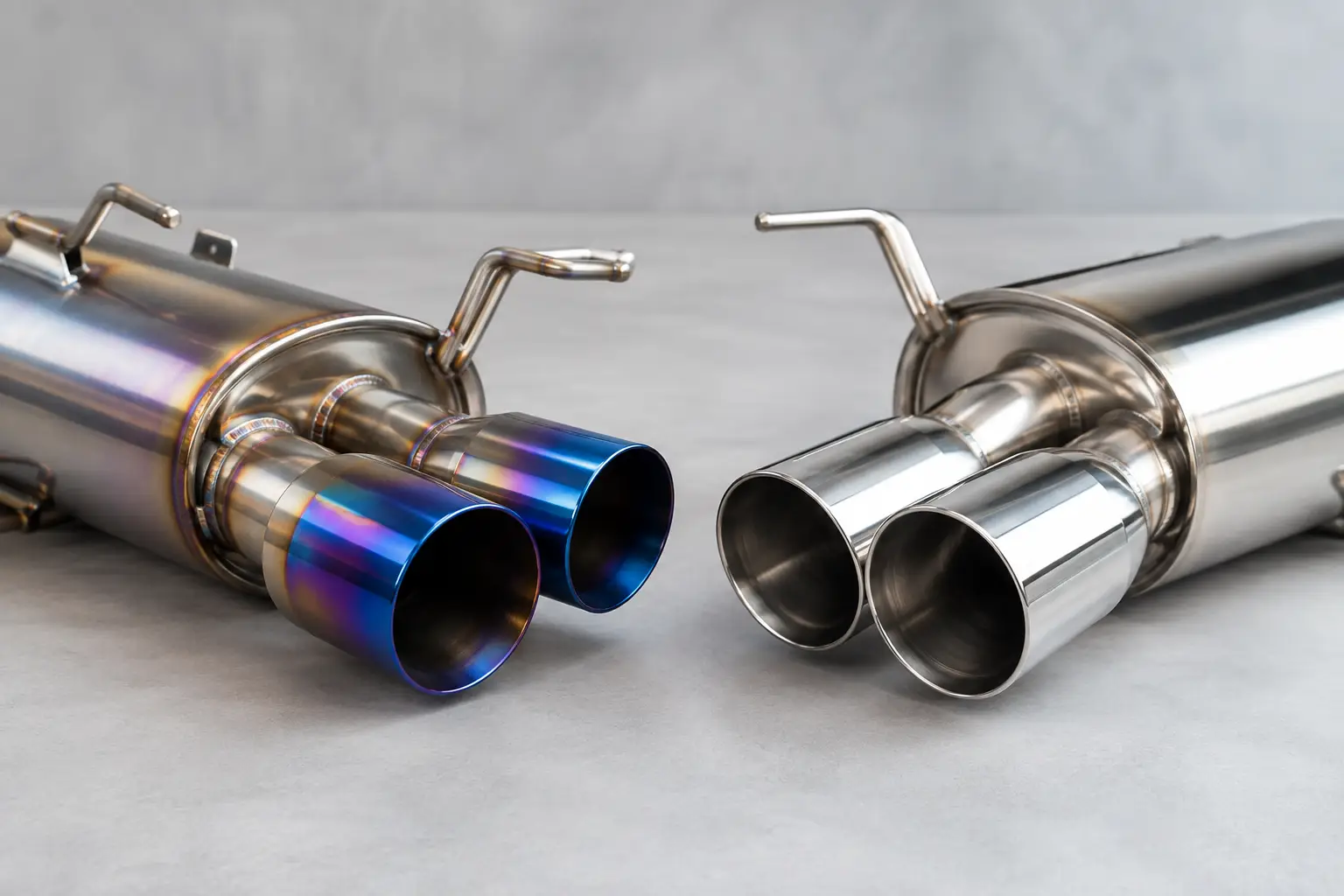
An axleback exhaust replaces only the rear-most portion of the system, generally from behind the rear axle to the tips. It typically includes the rear muffler section and tips, though the exact cut point varies by chassis. On many modern Audi, BMW, and Volkswagen models, it retains the factory midpipe and resonator while replacing the restrictive or quiet rear section.
That difference matters because the midpipe and resonators have a major influence on both sound control and exhaust flow. An axleback changes the car’s final voice. A catback changes more of the acoustic system itself.
What an Axleback Does Best
An axleback is often the smart move when the goal is a better sound with straightforward installation and a more controlled budget. Quality systems can deliver a deeper idle, more presence under throttle, and cleaner tip appearance while retaining much of the factory refinement during normal driving.
This makes axlebacks especially attractive for owners of newer performance cars with complex factory exhaust valve systems. If the original center section remains in place, the car usually keeps much of its OEM drone control and overall cabin civility. For a daily-driven S4, M340i, Golf R, or C43, that can be exactly the point.
Axleback systems also make sense when the factory exhaust is not the limiting factor for the current power target. On a stock-turbo vehicle running a conservative ECU tune, the performance difference from a rear-section-only system may be modest. The owner is buying sound, appearance, and premium construction rather than chasing a large horsepower number.
That does not make an axleback a lesser-quality choice. A properly engineered valved axleback with high-grade stainless steel, precise hangers, quality welds, and vehicle-specific fitment is a serious upgrade. It simply has a narrower purpose.
The limits of an axleback
Because it retains the stock midpipe, an axleback cannot fully address restrictive factory resonators, smaller-diameter tubing, or an overly muted center section. It also offers less control over the exhaust note once other modifications enter the picture.
For example, adding high-flow downpipes to a turbocharged BMW or Audi can significantly increase volume and alter frequencies. A rear section that sounded excellent with stock downpipes may become too sharp, boomy, or aggressive afterward. The retained factory midpipe can help in some cases, but it may also become the bottleneck in a build designed for substantially higher output.
Where a Catback Earns Its Place
A catback provides a complete rear exhaust solution. By replacing the midpipe and rear sections, it gives the manufacturer more control over diameter, crossover design, resonator placement, valve integration, and overall sound character. That matters when building a system that must flow well without producing uncontrolled resonance.
On a tuned MQB car, a catback may use larger tubing and a resonated center section to support better flow while keeping the cabin livable. On a BMW S58, the choice of single midpipe, equal-length midpipe, or X-pipe-style design can significantly change the sound from subdued and bass-heavy to sharper and more exotic. Those differences are impossible to achieve with a rear section alone.
The potential performance gain is also greater with a catback, particularly on modified turbocharged applications. Expectations should remain realistic: the exhaust behind the catalytic converters is rarely the first restriction on a stock vehicle. But as boost, airflow, and turbo size increase, a freer-flowing catback can better support the rest of the package.
For high-horsepower builds, exhaust temperature management, reduced backpressure, and durable material selection become more relevant than peak dyno numbers alone. A premium 304 stainless steel or titanium system can also reduce weight, depending on the factory hardware it replaces.
Sound tuning is the real advantage
The strongest case for a catback is often sound quality, not headline horsepower. The added components allow engineers to manage frequencies that cause cabin drone around common cruising RPM. Resonators can soften harshness without erasing the performance note. Valves can preserve a quieter mode for daily use while opening the system when the drive mode and throttle demand it.
Not every catback is quiet, and not every non-resonated system is unpleasant. It depends on engine configuration, turbocharger placement, transmission gearing, cabin insulation, and the rest of the exhaust. A four-cylinder MQB car, a five-cylinder 2.5 TFSI, and a six-cylinder S58 will respond very differently to similar-looking exhaust hardware.
Power, Sound, Cost, and Installation
The cost gap between catback and axleback systems is substantial because the catback includes more material, more fabrication, and more vehicle-specific engineering. That investment can be worthwhile when the car is part of a long-term performance plan. It may be unnecessary when the goal is simply to improve the rear-end appearance and add character to an otherwise stock car.
Installation follows the same pattern. An axleback is generally quicker because it uses fewer sections and retains more factory exhaust hardware. A catback can still be a bolt-on installation, but it involves more connections, more alignment work, and more opportunity for interference if the vehicle has aftermarket bracing, a diffuser, or nonstandard rear aero.
Fitment should never be treated as an afterthought. Confirm the exact chassis, model year, engine, drivetrain, body style, factory valve configuration, and whether the car has an OPF/GPF-equipped or other market-specific exhaust setup. A system designed for a rear-wheel-drive sedan may not fit an xDrive model, wagon, or coupe even when the engine is shared.
Choosing the Right System for Your Build
Choose an axleback when you want a clean, premium sound upgrade, retain factory midpipe refinement, and do not need the extra flow or tuning range of a complete system. It is a particularly strong choice for stock or lightly modified street cars where daily drivability matters as much as startup volume.
Choose a catback when you want greater authority over sound, plan to add supporting power modifications, or need an exhaust designed around a specific character such as resonated, non-resonated, valved, equal-length, or X-pipe-equipped. It is usually the more complete solution for enthusiasts who are building toward a defined power goal rather than making a single cosmetic or acoustic change.
Before ordering either setup, consider the parts already on the car and the parts planned six months from now. Downpipes, turbo upgrades, transmission tuning, and even a different rear diffuser can change what makes sense. EAS Store can help confirm platform-specific compatibility so the exhaust supports the build rather than becoming the next part that has to be replaced.
A great exhaust should make the car feel more purposeful every time it starts, without making every highway mile feel like a compromise. Match the system to the vehicle’s current configuration, its realistic future power target, and the way it is actually driven.