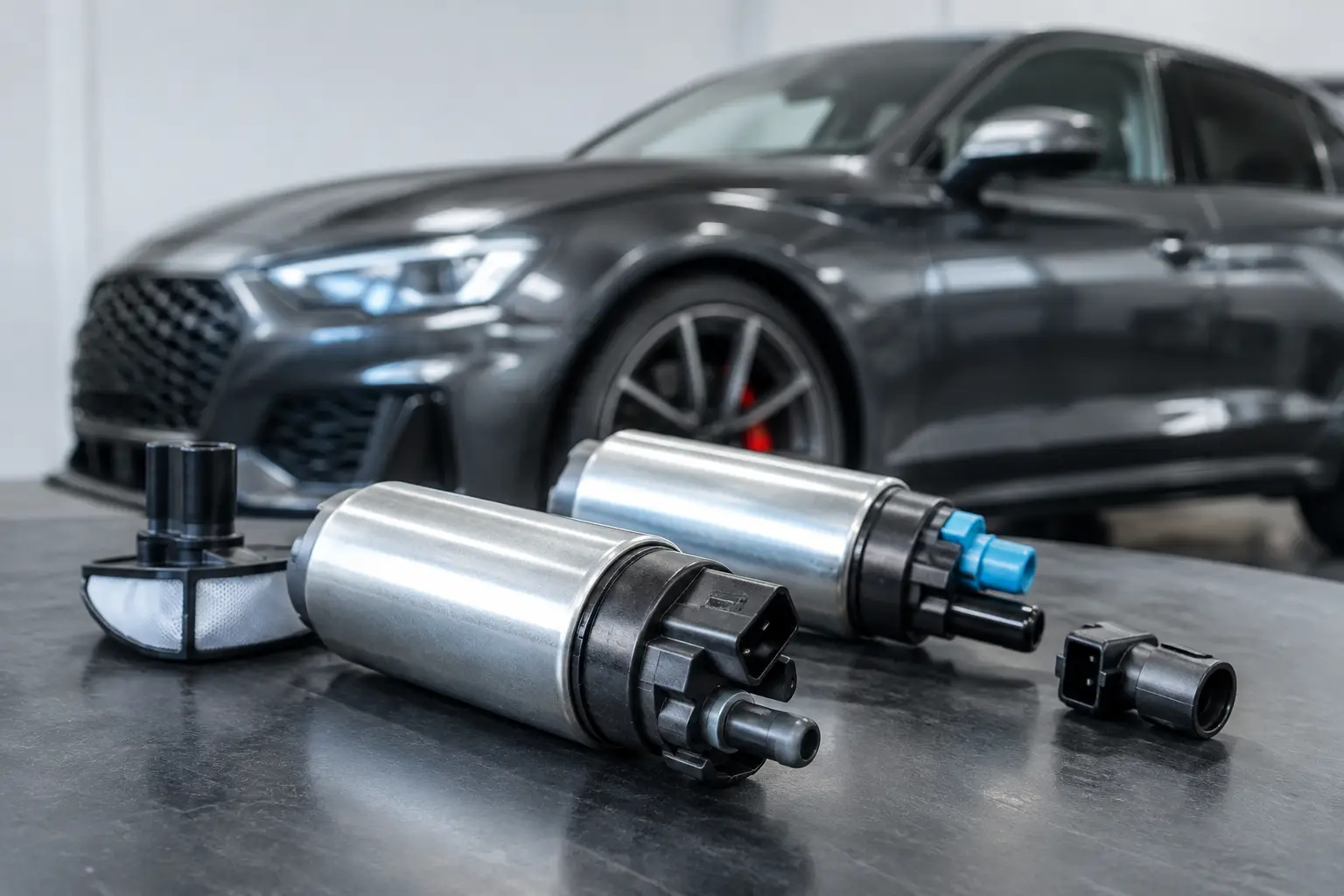
A tuned RS3 that pulls cleanly to redline on pump gas can become a very different car when ethanol content rises and boost follows. Fuel pumps are often the point where an otherwise well-planned build runs out of safe headroom. When pressure drops at high load, the result is not simply a lower dyno number. It can mean lean operation, timing correction, rail-pressure faults, and expensive engine damage.
For European performance platforms, the correct pump choice starts with a simple question: what fuel volume must the engine receive at your target power, at your actual fuel pressure, in real driving conditions? That answer depends on more than horsepower. Fuel type, injection strategy, voltage supply, factory fuel-system design, and intended use all matter.
Fuel Pumps Are a System, Not a Single Part
Many late-model Audi, Volkswagen, BMW, and Mercedes engines use direct injection. These cars generally have two fuel-delivery stages: a low-pressure fuel pump in or near the tank, and a mechanically driven high-pressure fuel pump at the engine. Both must have adequate capacity. Upgrading only one side may move the restriction, but it will not create a complete fueling solution.
The low-pressure side supplies fuel from the tank to the high-pressure pump. On a direct-injected MQB EA888, Audi 2.5TFSI, or BMW S58, it must maintain stable feed pressure while the engine is consuming fuel at maximum load. If the in-tank pump cannot keep up, the high-pressure pump has less fuel available to compress. Rail pressure can then fall even if the high-pressure pump itself is capable of more flow.
The high-pressure side is responsible for delivering fuel to the injectors at the pressure required by the direct-injection system. Upgraded high-pressure fuel pumps are common on cars running larger turbochargers, ethanol blends, or calibrated performance software. Their benefit is application-specific. A pump that supports a strong ethanol blend on one engine may not be the right answer for another platform with different injectors, cam-lobe geometry, rail targets, or calibration limits.
Port-injected builds add another layer. Auxiliary port injection can provide the additional fuel volume that the factory direct-injection system cannot supply at elevated power. But those injectors still rely on a properly sized low-pressure system, fuel lines, regulator strategy, controller, and electrical supply. A larger injector does not solve a low-pressure pump that is already losing pressure.
Why E85 Changes the Fueling Conversation
E85 is popular for good reason. It offers significant knock resistance and can support more aggressive boost and ignition timing than standard pump gas. The trade-off is volume. Ethanol-based fuel requires substantially more flow to make equivalent power, commonly around 25 to 35 percent more depending on ethanol content and tune.
That is why a fuel system that appears comfortable on 93 octane can reach its limits quickly on E50, E60, or full E85. The correct approach is to size for the fuel you will actually run, not the fuel you hope to use occasionally. If your build will see high ethanol content during track days, roll racing, or hot-weather pulls, that is the condition the system must support.
Fuel quality and ethanol percentage also vary. Flex-fuel hardware and calibration can help the engine adapt, but they do not replace mechanical capacity. When selecting components, leave a reasonable margin rather than building to the exact calculated limit. Pressure stability under heat, low tank level, and sustained acceleration is more valuable than a setup that barely meets the number on a cool dyno pull.
Selecting Fuel Pumps by Power Goal and Platform
Start with the platform, engine code, turbocharger, and fuel type. Then define a realistic power target. A daily-driven Stage 2 BMW may only require a targeted high-pressure upgrade or a modest low-pressure solution. An 800-plus-horsepower Audi RS3 with a built engine, larger turbo, and ethanol blend is an entirely different fuel-system project.
Do not shop by advertised flow alone. Flow ratings can be quoted at different pressures and voltages, which makes direct comparison misleading. A pump’s output declines as pressure rises, and voltage drop can materially reduce available flow. The relevant number is the system’s delivered capacity at your operating pressure and voltage, with your fuel.
For factory-style tank systems, fitment is as important as output. The pump assembly may need to retain the factory fuel-level sender, transfer components, bucket arrangement, and jet-pump function. A pump that physically fits but disrupts the tank’s scavenging system can uncover the pickup during hard cornering or acceleration. That is not acceptable for a car that sees track use or repeated full-throttle runs.
A drop-in low-pressure fuel pump upgrade is often the cleanest choice for a street car when it is designed specifically for the chassis. It preserves factory-style packaging while increasing flow. At higher power levels, staged dual-pump systems, brushless pump assemblies, surge tanks, or return-style conversions may be appropriate. These solutions can provide major capacity, but they add complexity, cost, heat management requirements, and installation time.
Electrical Capacity Is Part of Fuel Capacity
High-flow fuel pumps draw more current, especially under high pressure and load. Treating wiring as an afterthought is one of the most common mistakes in serious builds. Undersized wiring, weak grounds, tired connectors, inadequate relays, or an overloaded factory control module can reduce pump voltage precisely when the engine needs fuel most.
A properly engineered system may require heavier-gauge wiring, dedicated fusing, a relay harness, or a controller designed for the pump’s current demand. Brushless pumps and modern pump controllers can offer improved efficiency and controllability, but they must be compatible with the vehicle’s electrical architecture and tuning strategy.
This does not mean every upgraded pump needs a complete custom electrical system. Many platform-specific upgrades are engineered to work with the factory controller within a defined performance range. The key is knowing that range. Once power, ethanol content, or duty cycle moves beyond it, the electrical system needs to be evaluated with the same care as the mechanical components.
Tuning, Data Logging, and Safety Margin
Fueling hardware and calibration must match. Installing a larger pump without the proper tune can create diagnostic faults or incorrect pressure control. Conversely, a calibration that requests more fuel than the hardware can deliver places the engine at risk.
Data logging is where assumptions meet reality. Review low-side pressure, high-side rail pressure, injector duty cycle where available, commanded versus actual lambda, fuel trims, and any fuel-pressure fault codes. On modern turbocharged European cars, logs should be reviewed at full load through the upper rpm range, where fuel demand is often highest.
Watch conditions beyond the ideal third-gear pull. Low tank level, high ambient temperature, heat soak, and extended pulls can expose limitations that a quick test does not. A fuel system with margin will maintain the pressure the calibration expects. A system at its limit may look acceptable one run and fall short on the next.
Common Fuel-System Mistakes
The first mistake is assuming the largest pump is always best. Excess capacity can be useful, but it does not excuse poor fitment, weak wiring, incompatible controls, or an unsuitable calibration. The right component is the one that meets the build’s demand while integrating correctly with the car.
The second is overlooking the high-pressure side on direct-injected engines. A high-flow in-tank pump cannot overcome a stock high-pressure pump that has reached its capacity. The reverse is also true: a capable high-pressure pump cannot create fuel that the low-pressure side cannot supply.
The third is ignoring the rest of the fuel path. Filter condition, fuel lines, fittings, injectors, regulators, fuel-pressure sensors, and tank components all affect delivery. On a high-output build, every restriction and every potential leak deserves attention.
Finally, avoid mixing parts based on forum recommendations alone. A setup that works for one driver’s turbo, fuel blend, altitude, and tune may not work for yours. Confirm compatibility by chassis and engine code, then match the system to documented power and fuel requirements. EAS Store can help serious builders narrow the options before a costly mismatch reaches the garage.
When to Upgrade Your Fuel System
Upgrade before fuel pressure becomes a problem, not after a lean event or rail-pressure fault. Larger turbochargers, ethanol conversions, upgraded injectors, port injection, and aggressive race calibrations are clear triggers for a fueling review. So are plans for repeated track sessions or drag-strip passes, where demand remains high longer than it does during a brief street pull.
A modest street build may need only one targeted component. A high-horsepower ethanol car may need an integrated low-pressure, high-pressure, electrical, and tuning package. The difference is not hype. It is the difference between a car that makes power once and a car that delivers it reliably every time you ask.
Build the fuel system around the car you intend to drive, the fuel you intend to buy, and the power you intend to keep. That approach leaves room for hard use, protects the engine, and makes the next performance upgrade a planned step instead of a rescue job.