A fuel system that works at 450 horsepower can become the limiting factor at 600, and a setup that supports a conservative 93-octane tune may be completely out of range once ethanol enters the plan. That is why knowing how to plan fueling upgrades before ordering parts matters. On modern European turbo platforms, the right answer is rarely just “bigger injectors.” It is a matched system built around power target, fuel choice, engine architecture, and the calibration that will control it.
Start With the Real Power Goal
Fueling decisions should begin with a number, but not a vague one. “I want more power” does not define injector size, pump capacity, or whether supplemental fueling is necessary. Establish a realistic wheel-horsepower target, then leave room above it for changing conditions, future modifications, and the limits of the fuel you intend to run.
A stock-turbo MQB car targeting 400 to 450 wheel horsepower on pump gas has very different needs from an Audi RS3 2.5TFSI aiming for 750 wheel horsepower on E85. The BMW S58 owner planning a hybrid-turbo street build faces another set of constraints, particularly when factory direct injection begins approaching its practical ceiling.
Build in a safety margin rather than specifying a system that is mathematically maxed out at your target. A fuel pump running near its limit can lose effective flow as voltage drops or fuel temperature rises. Injectors held at excessive duty cycle leave the tuner with little ability to control the engine under load. Extra capacity is not wasted when it protects consistency.
Choose the Fuel Before Choosing the Hardware
Fuel type drives the entire plan. Pump 91 or 93 octane generally demands less volume than ethanol blends, but it also offers less knock resistance. E85 can support considerably more power and boost when properly tuned, yet ethanol requires substantially more fuel volume for the same power output.
That difference catches out many otherwise well-planned builds. A low-pressure pump that is comfortable on 93 may become inadequate on E60 or E85. The same applies to injectors, fuel lines, filters, fittings, and controllers. If flex-fuel capability is part of the long-term vision, plan for ethanol-compatible components from the beginning instead of replacing the system in stages.
Fuel availability deserves an honest assessment as well. A dedicated E85 calibration is only useful if quality ethanol is consistently available near where the vehicle is driven. For a street car that travels, a flex-fuel setup can offer more practical value than chasing the highest possible ethanol-only dyno number. For a track or drag build with controlled fuel supply, a dedicated race-fuel strategy may make more sense.
Understand Your Platform’s Fueling Architecture
Modern European performance engines use different systems, and the upgrade path depends on what the factory configuration can support. Direct injection, port injection, and combined direct/port arrangements each have different strengths.
Direct-injection limits
Many Volkswagen, Audi, BMW, and Mercedes engines rely on high-pressure direct injection from the factory. This provides precise fuel control and strong drivability, but it has a finite flow ceiling. As airflow and boost rise, the system may need a higher-capacity high-pressure fuel pump, upgraded injectors where available, and increased low-pressure supply to feed the high-pressure side.
The high-pressure pump is not a standalone answer. If the in-tank pump and low-pressure circuit cannot maintain supply, the upgraded high-pressure pump cannot create fuel volume that is not there. Review low-side and high-side pressure data together when assessing a system.
Supplemental port injection
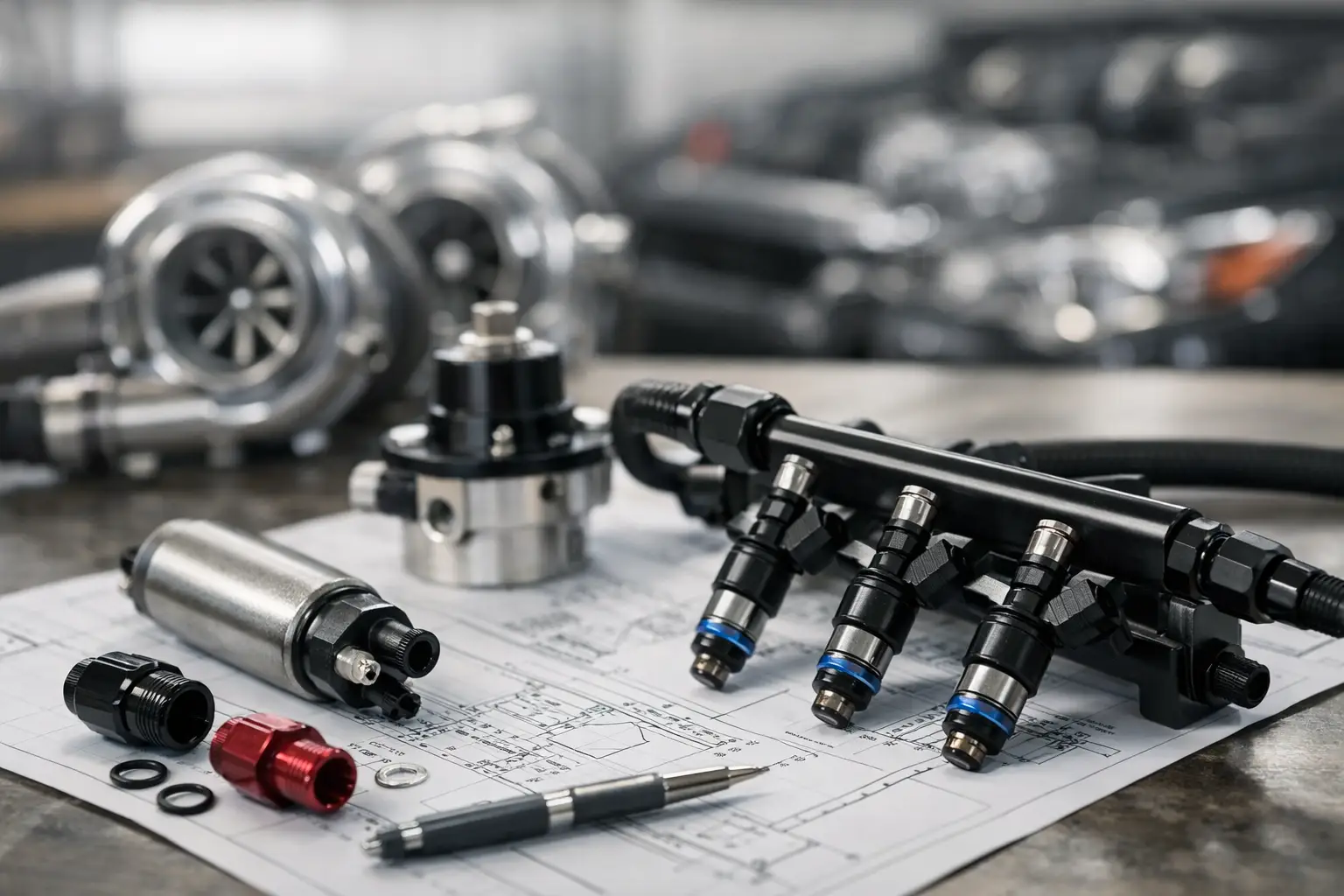
When direct injection reaches its effective limit, supplemental port injection can provide the additional volume required for high-output applications. This is common on serious MQB, 2.5TFSI, and S58 builds running larger turbos and ethanol blends. A port-injection solution typically involves an intake manifold or spacer arrangement, fuel rail, injectors, lines, and a controller or ECU strategy capable of managing the additional fuel.
Port injection can offer the headroom needed for major power, but it adds complexity. Injector characterization, controller integration, fuel distribution, and tuning all need to be right. This is not a place to mix unrelated components without confirming how the complete package will be calibrated.
Size the Low-Pressure System as a System
The in-tank pump is often called the low-pressure fuel pump, or LPFP, but the upgrade is bigger than the pump itself. Electrical supply, pump controller capacity, fuel bucket design, feed lines, filter restriction, and fuel pressure regulation can all affect delivered flow.
A high-flow pump may require a dedicated wiring upgrade or controller solution so it receives stable voltage under load. On a hard launch, sustained road-course corner, or high-speed pull, fuel slosh and voltage loss can expose weaknesses that never appear during casual street driving. The goal is stable pressure when demand is highest, not merely impressive advertised pump flow.
For ethanol builds, verify that every part of the low-pressure system is rated for ethanol exposure. Materials, seals, and filter media matter over time. Also consider the intended use: a street car with a half-full tank sees different conditions than a drag car launching aggressively or a road-course car pulling sustained lateral G.
Match Injectors to the Control Strategy
Injector selection is about more than maximum flow. The injector must work with the fuel rail, intake configuration, electrical connectors, ECU or supplemental controller, and intended fuel. A large injector with poor low-pulse-width control can make idle and part-throttle behavior harder to tune, especially on a car that still sees daily street use.
For port-injection systems, use injectors with known data for the controller and tuner involved. Flow rating alone is not enough. Dead time, voltage compensation, spray pattern, fuel pressure, and calibration data all affect how accurately fuel is delivered.
This is one area where buying a proven package can reduce risk. EAS Store supports performance-focused European builds with parts selected around specific platforms, helping owners avoid a fuel rail, injector, or fitting combination that looks compatible on paper but creates problems during installation or tuning.
Plan the Tune at the Same Time
No fueling upgrade is complete until it is calibrated. Changing pump capacity, injector size, ethanol content, or supplemental fueling changes how the engine must be commanded. The ECU needs to know what hardware is installed, and the tuner needs accurate details on fuel type, boost targets, turbocharger, intake, exhaust, and sensor configuration.
Choose the tuning route before purchasing components. Some platforms are best served by a factory ECU calibration with upgraded direct-injection hardware. Others require a supplemental controller for port injection, while high-level race applications may benefit from a standalone ECU. The best option depends on the platform, power goal, emissions requirements, and how much integration the build requires.
Data logging is part of the plan, not an optional final step. Monitor low-side pressure, rail pressure, injector duty cycle where available, air-fuel ratio, ethanol content, intake air temperature, and knock feedback. If pressure drops at high RPM, do not assume the tune is the problem. It may be a pump, controller, wiring, pickup, filter, or fuel-delivery limitation.
Avoid the Common Upgrade Mistakes
The most expensive fueling mistakes usually come from planning only for the next modification. Installing a pump that supports the current turbo but not the turbo planned for next season creates duplicate labor and duplicate purchases. On the other hand, oversizing every component without considering control strategy can create drivability and tuning challenges that a street car does not need.
Avoid these four shortcuts:
- Choosing parts by advertised horsepower alone, without accounting for fuel type and actual wheel-power target.
- Upgrading the high-pressure side while overlooking low-pressure pump flow, electrical supply, and fuel pressure stability.
- Adding port injection without confirming controller compatibility, injector data, and tuner support.
- Treating fuel-system installation as a cosmetic job rather than checking leaks, wiring quality, hose routing, and heat exposure.
There is also a practical service consideration. Filters need replacement intervals, ethanol systems benefit from regular inspection, and any car that sits for extended periods needs sensible fuel management. Premium components help, but maintenance and installation quality still determine whether the system performs reliably over years of use.
Build for the Car You Actually Drive
A 900-horsepower drag-oriented fueling system is not automatically the right solution for a 500-horsepower daily-driven S3 or M240i. Consider cold starts, stop-and-go behavior, long-distance driving, track heat, service access, and the quality of fuel available in your area. The strongest build is one that delivers its intended power repeatedly without making the car harder to own.
Start with a clear target, select fuel first, verify the limits of your platform, and choose components that work together under the tuning strategy you will use. When the fuel system has enough controlled capacity for the engine’s real demand, every other power upgrade has a far better foundation to perform on.