A downpipe is one of the first hardware changes G80 M3, G82 M4, and G83 M4 owners consider because the factory S58 responds quickly when exhaust restriction is reduced. But a useful S58 downpipe review has to go beyond the usual promises of more power and louder turbo sound. The right setup depends on your tuning plan, local emissions requirements, tolerance for cabin noise, and whether the car is a daily driver, weekend canyon carver, or dedicated track build.
For a platform already capable of serious output with calibration alone, downpipes are not simply a cosmetic exhaust upgrade. They change the conditions around the S58’s twin turbos, affect how a tune is calibrated, and can influence ownership experience every time the car starts, cruises, or goes through inspection.
What an S58 Downpipe Changes
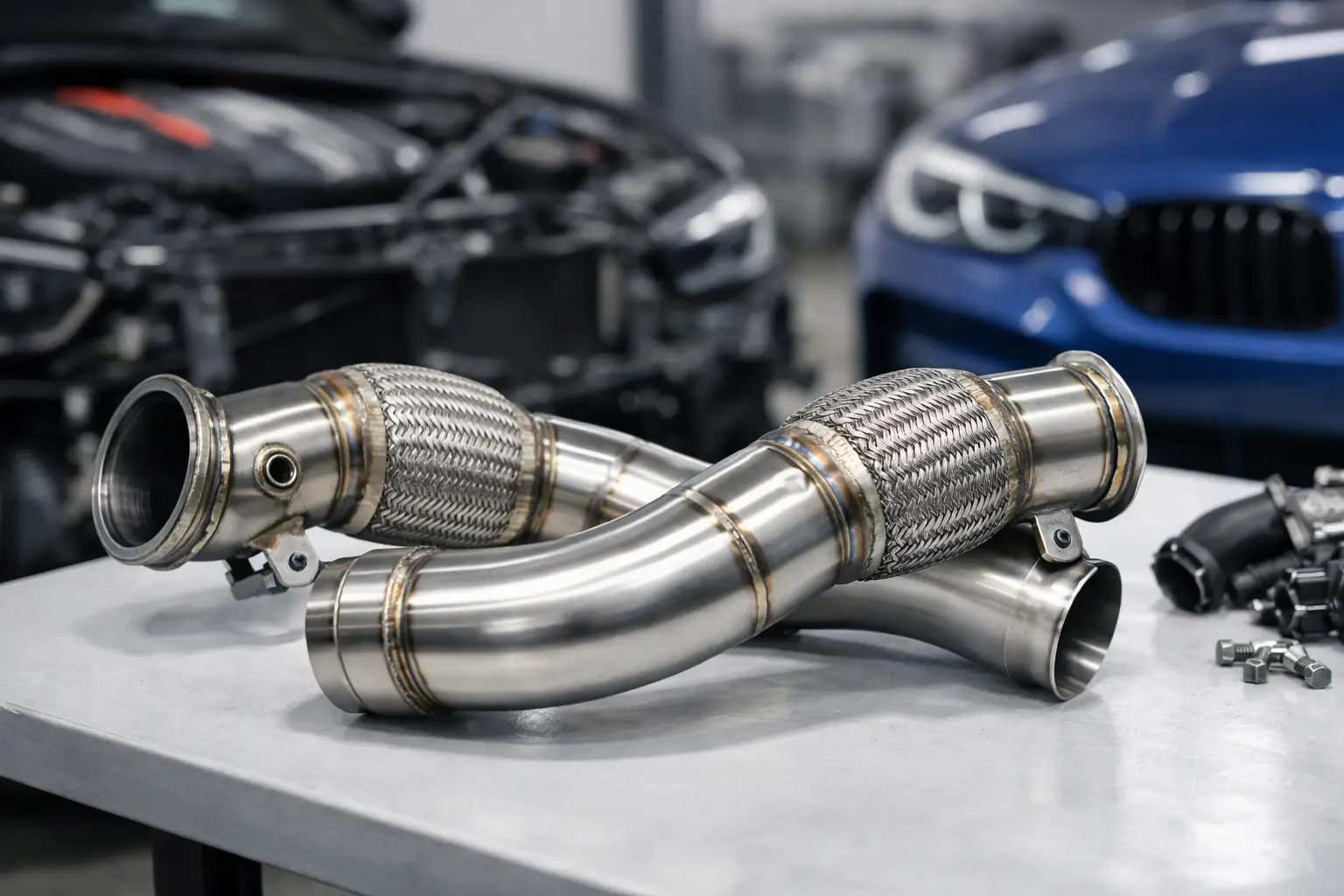
The S58 uses two turbochargers and two downpipes, one serving each turbo. The factory units include restrictive catalytic converter assemblies designed around cold-start emissions performance, noise control, and long-term OEM compliance. Replacing them with higher-flow components reduces backpressure after the turbines.
Less post-turbine restriction helps the turbos move exhaust gas more efficiently. In practical terms, that can improve spool response, support stronger midrange torque, and create more headroom when the car is running an aggressive Stage 2-style calibration. On a stock-tuned car, the gains are typically more limited than the marketing numbers attached to a tuned setup. The hardware is capable of more, but the factory calibration is still the limiting factor.
This is why a downpipe should be selected as part of a package rather than as an isolated modification. Intake flow, charge cooling, fuel quality, ECU calibration, and the intended power target all matter. A street car targeting a responsive 600-plus horsepower setup has different needs from an ethanol-fueled build pursuing significantly higher numbers.
S58 Downpipe Review: Catted vs. Catless
The largest decision is not pipe diameter or finish. It is whether to choose high-flow catted downpipes or catless downpipes.
High-flow catted options are the more balanced choice for many street-driven G8X cars. A quality metallic substrate catalyst can reduce restriction compared with the original equipment units while keeping exhaust odor, harshness, and cold-start volume more manageable than a fully catless system. They generally cost more because the catalyst material and construction quality matter, especially in the S58’s high-heat environment.
Catless downpipes offer the least restriction and the most aggressive change in exhaust character. Turbo spool becomes more apparent, the exhaust gets sharper under load, and the car may produce a stronger raw fuel smell. They are commonly used in off-road or competition-focused builds where maximum flow takes priority. They also create more complications for a car that sees public roads.
Neither design automatically guarantees a specific power figure. On a properly calibrated higher-output S58, both can support meaningful gains over stock. The difference between a premium catted system and a catless system may be smaller than many buyers expect when the rest of the package, fuel, and tune are held constant. The bigger distinction is usually drivability, sound, odor, emissions equipment, and legal use.
Under United States federal law, removing or tampering with emissions-control equipment on a vehicle used on public roads is prohibited. State and local requirements can be stricter, and visual inspections, OBD readiness checks, and sound enforcement vary widely. Buyers should verify the laws that apply where the vehicle is registered and operated before purchasing any downpipe configuration.
Real-World Power Expectations
A downpipe alone is not a magic horsepower part. The factory ECU is designed to protect the engine, turbos, catalyst system, and drivetrain within factory operating limits. Without a calibration designed to take advantage of the additional flow, the performance difference may feel modest.
With appropriate supporting tuning, the improvement becomes more noticeable. The S58 tends to reward reduced exhaust restriction with faster torque delivery and stronger pull through the midrange, particularly when paired with suitable fuel. The most convincing benefit is often not peak dyno horsepower but how quickly the car responds when you roll into the throttle from 3,000 to 5,500 rpm.
A serious tune should account for boost targets, ignition timing, fuel pressure, lambda targets, exhaust gas temperature, and torque management. Chasing a peak dyno number without considering these controls is a poor strategy for a premium BMW platform. The S58 is a strong engine, but reliable high-output results still come from a matched combination of parts and calibration.
For cars moving toward ethanol blends, upgraded fueling, larger turbos, or track use, downpipes become even more relevant. At that point, the goal is not merely to add power. It is to remove a restriction that can become more significant as exhaust volume and turbine demand increase.
Sound, Smell, and Daily-Driver Trade-Offs
Downpipes change the G8X driving experience as much as they change airflow. The S58’s exhaust note gains more turbo presence, more crackle on overrun, and more volume under full load. Some owners want exactly that. Others install downpipes and later discover that cold starts, low-speed cruising, or Sport Plus mode are more dramatic than expected.
Catted downpipes generally deliver a more controlled result. The car remains louder and more urgent than stock, but the exhaust has less rasp and less unburned-fuel odor than a catless setup. Catless downpipes are typically the louder option, though the final sound depends heavily on the rear exhaust system, resonators, software settings, and whether the vehicle retains its factory muffler.
If the car is used for commuting, passenger trips, or long highway drives, consider the complete exhaust path before buying. A downpipe paired with the stock rear exhaust is very different from a downpipe combined with a resonator delete and an aggressive valved cat-back. The latter may be ideal for a track-oriented build but tiring for some owners on a daily-driven M3 or M4.
Fitment and Build Quality Matter More Than They Seem
The G8X engine bay and underbody packaging leave little room for poor manufacturing. A properly engineered S58 downpipe set should have accurate bends, correct flange geometry, consistent welds, reliable O2 sensor bungs, and enough clearance around heat-sensitive components. Cheaply made pipes can create installation frustration before the car ever reaches the road.
Material selection matters as well. Quality stainless construction is expected for a part exposed to repeated heat cycles, moisture, and road contamination. Well-designed flex sections help manage engine movement and reduce stress on joints. Fitment should allow the factory-style clamps, brackets, and sensors to be installed without forcing alignment or placing tension on the exhaust assembly.
This is not the place to buy solely by the lowest advertised price. Poor fitment can lead to exhaust leaks, rattles, sensor-related problems, or additional labor that quickly erases the initial savings. Specialty suppliers such as EAS Store can help verify application details before a buyer commits, particularly when the vehicle has other exhaust or tuning modifications already installed.
Tuning, Engine Lights, and Diagnostic Reality
Many buyers ask whether an S58 downpipe will trigger a check-engine light. The honest answer is that it can, especially when the factory catalyst-monitoring strategy sees readings outside its expected range. This is most common with catless systems, but high-flow catted components can also affect monitoring depending on the hardware, software version, operating conditions, and calibration.
Do not assume that a spacer, simulator, or generic workaround will provide a reliable answer. Modern BMW diagnostics are sophisticated, and a car that appears fine during one drive cycle may still show faults or fail readiness monitors later. Any tuner involved in the build should be clear about what their calibration supports and what it does not.
It is also worth distinguishing a drivetrain malfunction message from a true downpipe issue. Installation-related exhaust leaks, damaged O2 sensor wiring, loose connectors, or incorrect sensor placement can all create faults. A careful installation and a post-installation inspection are part of doing the job correctly.
Who Should Buy S58 Downpipes?
Downpipes make the most sense for owners building beyond a basic stock-calibration car and willing to accept the related tuning, sound, and compliance considerations. They are especially appropriate when the goal is stronger turbo response, a more aggressive exhaust character, or supporting airflow for a higher-output S58 package.
For a driver who wants a quiet, fully emissions-compliant daily M3 or M4, the factory downpipes remain the sensible choice. For the owner who wants extra character without going all-in on a race-car experience, premium high-flow catted downpipes are often the more livable direction. For competition-only projects, catless hardware may offer the flow and simplicity required by the build, provided the car is used accordingly.
The best purchase is the one that matches the car you actually drive, not the loudest setup in a video clip. Start with your power target, confirm your local requirements, and choose downpipes that fit the rest of the S58 package with the same care you would give fuel, cooling, and calibration.