A high-flow intake that does not match your exact platform is not an upgrade. It can create installation headaches, trigger airflow-related fault codes, interfere with factory hardware, or simply deliver less than the result you expected. If you are asking, “which intake fits my car,” start with the vehicle’s chassis, engine code, turbo configuration, and current tune – not the shape of the air filter.
For European performance platforms, fitment is often more specific than model year and badge. An intake listed for an Audi S3 may not fit every S3 engine generation. A BMW M car may share a chassis family while using a completely different airbox layout. The right system should fit cleanly, support your power target, and work with the rest of the hardware already on the vehicle.
Which Intake Fits My Car? Start With Platform Data
The reliable fitment check begins with four details: year, make and model, chassis code, and engine code. Your VIN is also valuable because it confirms production details that a registration lookup can occasionally miss.
Chassis codes identify the underlying vehicle generation. Examples include Volkswagen Mk7 and Mk8, Audi 8V and 8Y, BMW F8X and G8X, and Mercedes W205. These codes matter because mounting points, duct routing, battery placement, radiator support design, and factory airbox dimensions can change between generations.
Engine codes matter just as much. The 2.0T found across the Volkswagen and Audi MQB family is not one universal application. EA888 Gen 3, Gen 3B, and Gen 4 installations have important differences in intake routing, turbo inlet dimensions, PCV connections, sensors, and software requirements. The same principle applies to BMW’s B58, S58, N54, N55, and S55 engines, even when the cars appear similar at a glance.
Before ordering, confirm whether the product is designed for your exact chassis and engine. Do not assume a part fits because the listing says it works on a “2.0T” or “3.0T.” That description is a starting point, not a final fitment confirmation.
Check Your Turbo and Intake Layout
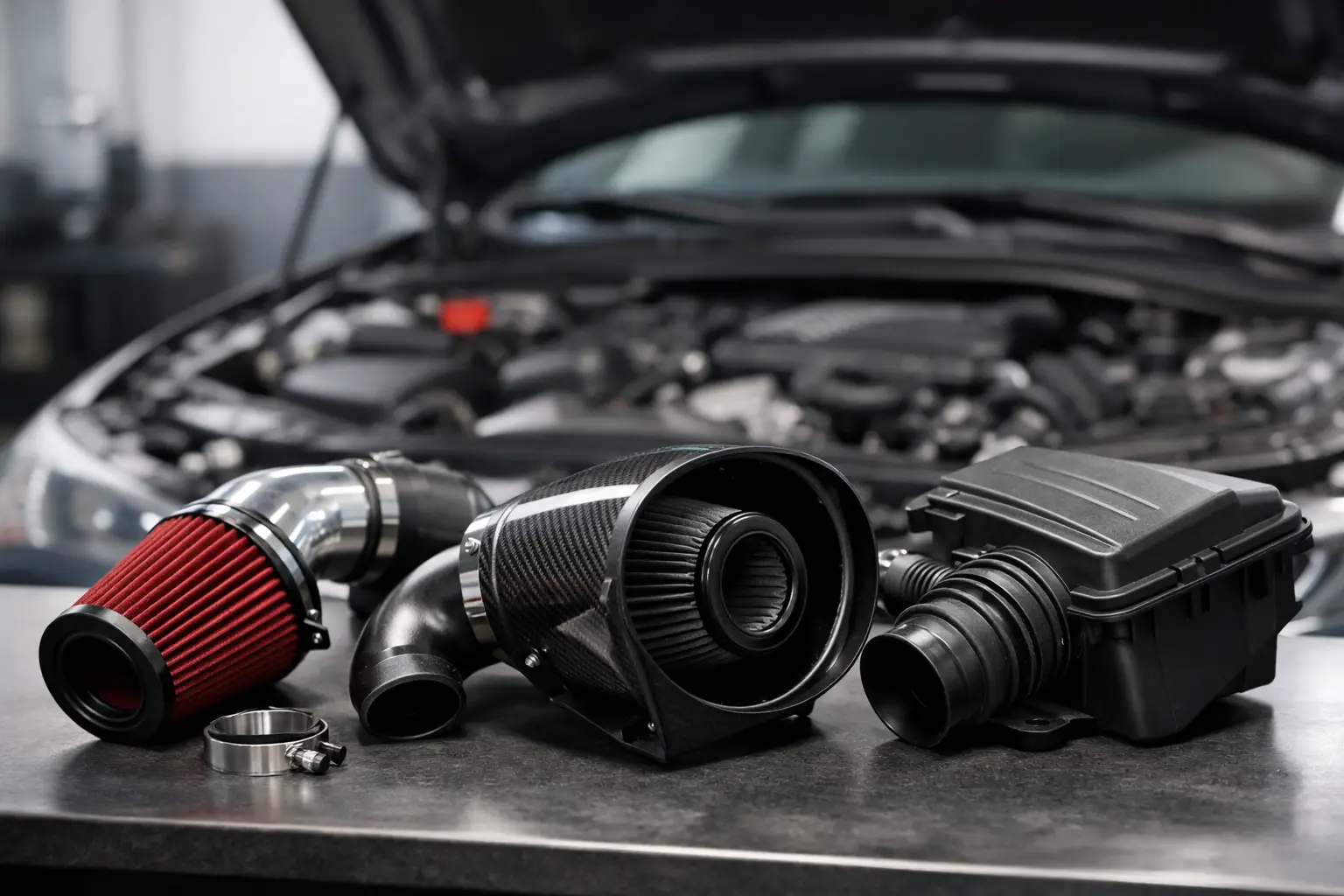
Turbocharged engines generally use an intake path made up of several separate pieces: the airbox or filter, intake tube, turbo inlet, and sometimes a separate inlet pipe or hose. On some platforms, a full intake replaces the airbox and pipe. On others, the best gains come from pairing an upgraded inlet with the factory-style airbox.
Single-turbo and twin-turbo layouts are not interchangeable. A BMW G8X S58 uses dual intake paths, while many B58 applications use a single path. An Audi RS3 or TTRS 2.5TFSI has its own high-flow requirements and packaging constraints. If you are building toward substantial horsepower, verify the inlet diameter, coupler size, and filter capacity rather than buying based on brand familiarity alone.
Choose the Intake Type for Your Actual Goal
An intake should match the build stage. The best choice for a stock daily driver is not automatically the best choice for a hybrid-turbo car, and the loudest system is not automatically the one that moves the most air.
Panel Filter and Factory Airbox Upgrades
For many modern European vehicles, the factory airbox is more capable than enthusiasts expect. A premium drop-in panel filter can be a sensible first step for a stock or lightly tuned car, particularly where the factory airbox draws cool air from outside the engine bay and retains a well-designed sealed enclosure.
This route typically preserves factory refinement, uses the original sensor location, and avoids unnecessary heat exposure. The performance change may be modest, but it can complement a tune without altering the car’s everyday behavior. It is a strong option when you want serviceability and a clean OEM-plus installation.
Open Intake Systems
An open-element intake replaces more of the factory assembly with a larger filter and freer-flowing pipework. These systems often make turbo spool, diverter valve, and induction sounds more noticeable. On a tuned car, they can reduce restriction where the stock inlet tract becomes a bottleneck.
The trade-off is heat management. An exposed filter can ingest warmer underhood air at low speed unless the system uses a properly sealed heat shield, effective air ducting, or both. Sound is also part of the decision. Some drivers want the sharper induction note; others want performance without additional cabin noise.
Closed Cold-Air Intakes
A closed intake combines a high-flow filter with an enclosed airbox or lid designed to pull air from a cooler factory or supplemental feed. It is often the most balanced choice for a street-driven performance car because it can improve flow while controlling inlet-air temperatures and maintaining a more refined appearance.
Closed systems are especially attractive on high-output street builds where repeatable performance matters. A system that produces impressive sound but heat-soaks after a few pulls is less useful than one that delivers stable airflow during real driving conditions.
Turbo Inlets and High-Flow Pipes
On many turbocharged applications, the restrictive section is not the filter itself. It may be the turbo inlet, a factory accordion hose, or a narrow transition before the compressor. An upgraded turbo inlet can be a meaningful supporting modification, especially on tuned MQB cars, B58 builds, and high-output 2.5TFSI applications.
However, inlet upgrades require careful matching. The diameter must suit the intake and turbo compressor inlet, and the system must retain or correctly relocate every breather, vacuum, and sensor connection. A larger part is not automatically better if it creates poor transitions or does not seal correctly.
Tune, Sensors, and Emissions Compliance Matter
Modern engines calculate airflow through carefully calibrated mass airflow sensors, speed-density strategies, or a combination of both. An intake that changes sensor housing diameter or placement can affect those calculations. Some systems are engineered to work with factory software, while others are intended for specific tuning calibrations.
Read the manufacturer requirements before installation. If a product calls for a tune, assume that requirement is part of the fitment. Running it without the necessary calibration can cause drivability issues, warning lights, or inconsistent fueling corrections.
Also check emissions rules where you register the vehicle. Certain intake systems are approved for use in emissions-controlled applications, while others are intended for off-road or competition use only. A part can physically fit your car and still be unsuitable for legal street use in your state. Keep the product documentation with the vehicle if your area requires emissions inspections.
Avoid the Most Common Intake Fitment Mistakes
The most expensive intake mistake is ordering by visual similarity. A filter, pipe, or inlet may look correct in a product photo while having the wrong sensor port, mounting bracket, or compressor connection.
Watch for these common problems:
- Selecting by model name without confirming chassis and engine generation.
- Ignoring changes made by a previous owner, such as an aftermarket turbo, relocated coolant reservoir, or modified charge piping.
- Mixing intake, inlet, and coupler parts from different systems without verifying diameters and connection styles.
- Choosing an intake designed for a factory turbo when the car now runs a larger hybrid or big-turbo setup.
- Forgetting emissions legality, tuning requirements, or automatic versus manual transmission fitment notes.
Installation details matter, too. A loose clamp after the MAF sensor, a pinched PCV hose, or an unseated turbo inlet can create a boost leak that feels like a tuning problem. Inspect every connection after the first heat cycle and confirm that the intake cannot rub on the fan shroud, hood, or engine cover under movement.
When a Bigger Intake Is Actually Necessary
A stock-turbo Stage 1 or Stage 2 street car often does not need the largest intake available. It needs a properly engineered system with adequate filter area, smooth internal flow, stable sensor behavior, and good heat control. Spending the difference on maintenance, tires, intercooler capacity, or tuning support may produce a more complete result.
The equation changes as airflow demand rises. Hybrid-turbo builds, ethanol blends, upgraded fueling, and sustained track use can expose restrictions that were irrelevant at stock power. For an 800HP-plus application, intake sizing, filter surface area, inlet geometry, and compressor compatibility become build-critical decisions. At that level, choose components around measured power goals and the turbo manufacturer’s recommended inlet requirements.
EAS Store supports enthusiasts who want to make that decision with the full build in mind. Provide your vehicle year, chassis, engine code, turbo setup, tune, and target power when requesting fitment guidance. Those details turn a broad category search into a parts recommendation that belongs on your car.
The right intake should disappear into the build once installed: no warning lights, no improvised brackets, no couplers under strain, and no question about whether it will support the next power step. Confirm the details before ordering, then let the engine do the talking.