A failed PCV assembly can feel exactly like a tuning problem: unstable idle, unexpected oil consumption, a whistle from the valve cover, or boost that will not hold where the calibration says it should. This MQB PCV upgrade guide is built for Volkswagen and Audi owners who want to choose the correct crankcase ventilation solution before a small diaphragm or check-valve failure becomes a drivability issue, a boost leak, or an oil-control problem.
On a stock daily driver, the latest OEM-style PCV assembly is often the right repair. On a higher-boost EA888 build, especially one used for repeated pulls, track days, or ethanol fueling, the correct answer may be a reinforced PCV solution, a properly engineered catch can system, or a complete ventilation strategy matched to the engine generation and turbo setup. The key is understanding what the factory system does before replacing it with a part that only looks more serious.
What the MQB PCV System Actually Does
The positive crankcase ventilation system manages pressure inside the engine while separating oil vapor from blow-by gases. At idle and light throttle, intake manifold vacuum pulls vapors through the PCV system so they can be burned in the combustion process. Under boost, the manifold side must close. Crankcase vapors are then routed through the breather path toward the turbo inlet, where the system can continue to pull a controlled amount of vacuum.
That change between vacuum and boost is where the assembly earns its keep. The PCV unit contains diaphragms, pressure-regulating passages, and check valves that must react correctly in both operating conditions. If the boost-side check valve leaks, pressurized intake air can enter the crankcase. If the diaphragm tears or the regulating section sticks, the engine may see too much vacuum, too little vacuum, or crankcase pressure when it should not.
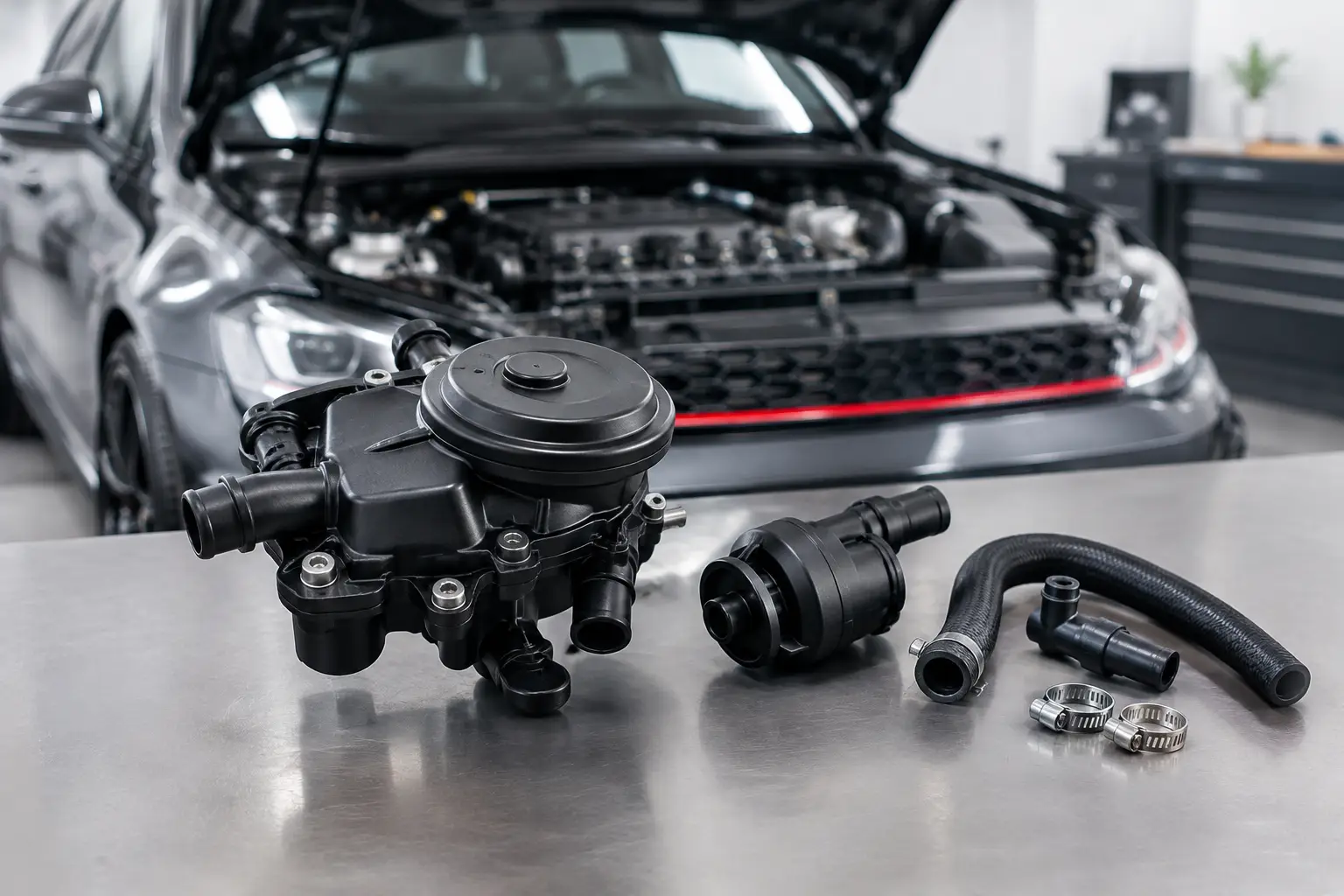
On many MQB EA888 applications, the oil separator and PCV hardware are integrated into the valve cover assembly. That means a PCV repair is not always as simple as swapping one small external valve. Fitment depends on engine generation, valve cover design, hose connections, sensor provisions, and the vehicle’s factory emissions equipment.
Signs Your PCV Is Failing
Do not order a PCV upgrade based on one symptom alone. A vacuum leak, failing diverter valve, charge-pipe issue, worn ignition components, or calibration problem can create similar complaints. Still, several signs should move the PCV system near the top of your diagnostic list.
A failed unit may cause a rough or hunting idle, misfire faults at idle, unusual suction at the oil cap, a high-pitched whistle, new oil seepage, or increased oil consumption. On a tuned car, it can also show up as inconsistent boost response or a pressure test that reveals leakage through the crankcase ventilation path. In more severe cases, excessive crankcase pressure can push oil past seals that were never designed to contain boost pressure.
A quick oil-cap test can provide a clue, but it is not a complete diagnosis. Some vacuum at the cap is normal. The concern is excessive suction, a dramatic idle change, obvious whistling, or a cap that is unusually difficult to remove because the diaphragm is regulating incorrectly. A smoke test, pressure test, scan data, and visual inspection of the PCV hoses will give a much better answer.
MQB PCV Upgrade Guide: Choose by Build Level
There is no universal best PCV upgrade for every MQB car. The right setup depends on whether the car is a stock commuter, a tuned street car, or a high-output build operating well beyond factory cylinder pressure.
Stock and mild Stage 1 cars
For a stock or lightly tuned EA888, a current-revision OEM replacement is usually the most reliable choice. Factory-style hardware preserves the intended vacuum behavior, emissions function, cold-weather operation, and hose routing. It is also the lowest-risk option when the original unit has simply aged, torn, or developed an internal check-valve issue.
Do not assume an older revision found at a discount is equivalent to the current part. Volkswagen and Audi frequently revise components for durability and drivability reasons. Confirm the part against the vehicle’s VIN, engine code, and valve cover arrangement rather than buying by model year alone.
Stage 2 and upgraded turbo street cars
Once boost, airflow, and cylinder pressure increase, the PCV system sees more demanding conditions. A quality upgraded assembly or reinforced diaphragm solution can make sense when it has been designed specifically for the EA888 generation in your vehicle. The goal is not simply a stiffer spring or a billet cap. The unit still needs to regulate crankcase vacuum correctly at idle and transition cleanly under boost.
This is where low-cost universal parts create expensive confusion. A part may physically bolt on yet have the wrong port configuration, check-valve behavior, or diaphragm calibration. That can introduce idle faults, oil vapor issues, and boost leaks that get blamed on the tune. Use a system engineered for your engine code and intended power range.
Big-turbo, ethanol, and track-focused builds
High-output MQB cars create more blow-by, especially under sustained load. A catch can system may be worthwhile for these applications, but it must be a closed, properly baffled system with routing that maintains the PCV system’s required functions. An open vent-to-atmosphere setup may reduce oil residue in the intake tract, but it can introduce odors, oil mist, poor cold-weather behavior, and emissions compliance concerns.
A catch can is not automatically an upgrade. A poorly designed can with restrictive fittings, weak internal baffling, or incorrect hose routing can create more crankcase pressure than the factory separator. On a serious build, choose components with appropriately sized lines, application-specific mounting, serviceable filtration, and proven compatibility with the factory PCV architecture or an engineered replacement strategy.
Gen 3 vs. Gen 4 Fitment Matters
MQB is a platform term, not an engine code. A Mk7 GTI, Golf R, Audi S3, 8V A3, Mk8 GTI, and 8Y S3 may all be described as MQB, but their EA888 generations and ventilation hardware can differ substantially. The 1.8T and 2.0T variants can also use different valve covers, breather layouts, and part numbers.
Before purchasing, verify the model year, engine code, front-wheel-drive or all-wheel-drive configuration where applicable, valve cover design, and current PCV part number. If the car has an aftermarket intake, turbo inlet, catch can, or auxiliary breather plumbing, confirm that those parts will retain the correct connections. A PCV solution that fits a Gen 3 Golf R may not fit a Gen 4 GTI without modification, and modification is rarely the best path for a pressure-control component.
Avoid These Common PCV Mistakes
The most common mistake is replacing the PCV system without testing for other air leaks. A smoke test of the intake tract and a boost-leak test can save time and prevent unnecessary parts swapping. Inspect the breather hoses, turbo inlet connection, valve cover sealing surface, and any aftermarket intake fittings while access is available.
Another mistake is deleting or bypassing factory plumbing because it appears restrictive. The EA888 PCV system is tied to idle quality, oil separation, fuel trims, and crankcase pressure management. Removing a hose or capping a port without a complete, purpose-built ventilation design can create a car that runs poorly even if it makes a clean dyno pull.
Finally, do not overlook maintenance. Even the best PCV hardware cannot compensate for neglected oil changes, excessive oil fill level, or an engine with elevated blow-by from mechanical wear. Use the specified oil viscosity and approval for your engine, keep the oil level correct, and inspect the system whenever the intake or valve cover area is apart.
Installation Priorities for a Reliable Result
Installation quality matters as much as the component choice. Start with a clean mounting surface and inspect the valve cover for warping, cracks, or damaged sealing areas. Replace seals and hardware when the manufacturer calls for it, and follow the specified torque sequence. Over-tightening plastic valve-cover components can create leaks or distortion that look like a failed new PCV.
After installation, clear relevant fault codes and let the engine reach operating temperature. Check idle quality, listen for leaks, and inspect every breather connection. If the car is tuned, log fuel trims, boost actual versus requested, and misfire data after a proper road test. A PCV repair should not create a new drivability issue, and a quality installation should hold up under the load the vehicle was built to handle.
For owners planning a complete MQB build, select PCV hardware with the same care used for fueling, intercooling, and calibration. EAS Store can help match premium ventilation components to the engine code and power target, so the part you install supports the build rather than becoming its next weak point.
The best PCV upgrade is the one that keeps crankcase pressure controlled in the real conditions your car sees – cold starts, daily traffic, full boost, and repeated hard use. Get the fitment right first, then let the rest of the build perform as intended.