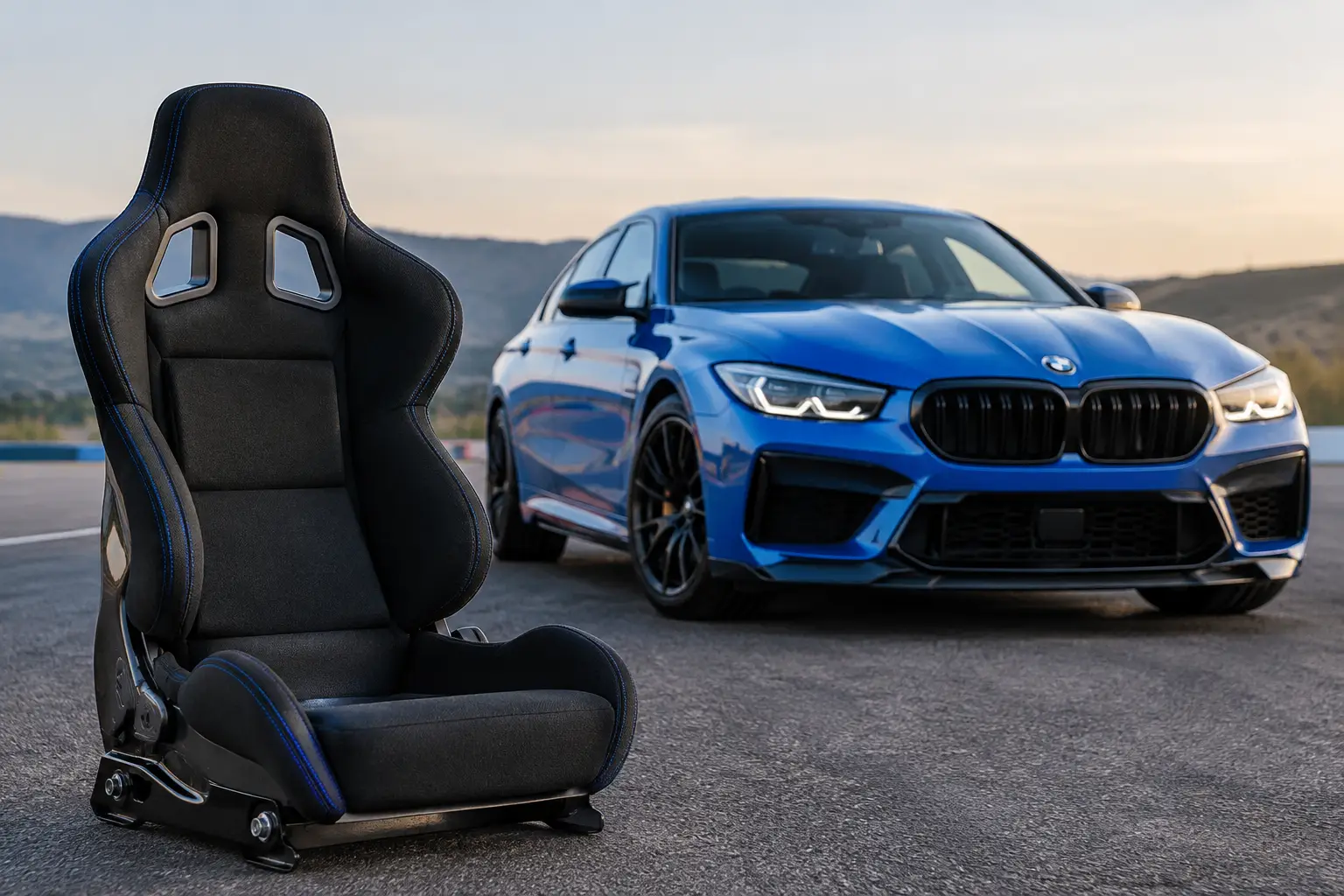
A BMW that makes serious power but leaves the driver sliding across the factory leather is only half-finished. The best racing seats for BMW build projects do more than change the cabin’s appearance. They lock in driving position, improve pedal control, give your harnesses a proper foundation, and make long track sessions less fatiguing.
The right choice depends on what the car actually does. A street-driven G80 M3 needs different compromises than an E46 track car on a fixed-back shell, and neither seat is automatically right for a dedicated time-attack or wheel-to-wheel build. Fitment, safety equipment, seating height, and chassis-specific mounting matter as much as the logo on the headrest.
Start With the Build, Not the Seat Brand
Before comparing shells, measure the mission of the car. For a BMW that sees commuting, canyon roads, and a few track days each year, a reclining sport seat can be the practical answer. It offers stronger lateral support than most OEM seats while retaining adjustability and easier rear-seat access in coupes.
For frequent HPDE use, time attack, or a car with a harness bar or roll bar, a fixed-back bucket is usually the better performance purchase. Its rigid shell supports the torso and shoulders consistently under braking and cornering. That consistency matters in a heavy, fast BMW, particularly a high-grip E9X M3, F8X, or G8X chassis that can generate serious braking and lateral loads.
A competition vehicle requires a more specific approach. Look at the rulebook first, then select an FIA-homologated seat with the required head containment, mounting method, and expiration status. A seat can be premium and extremely well made yet still fail to meet the class requirements for the series you intend to run.
Best Racing Seats for BMW Build Types
There is no single best seat for every BMW. The best choice is the one that fits the driver, clears the chassis, and works correctly with the rest of the restraint system.
Reclining sport seats for street and track cars
A quality reclining seat from established motorsport-focused manufacturers is a strong fit for a dual-purpose BMW. These seats generally provide a familiar seating experience, recline adjustment, and a more manageable entry and exit process than a fixed shell. They are especially appealing in cars where passengers, rear-seat access, or daily usability still matter.
The trade-off is structural. Reclining mechanisms add weight and introduce moving parts, while the seat’s belt routing and harness compatibility may be more limited than a dedicated bucket. If you plan to run a multi-point harness, confirm that the seat is explicitly designed for the belt configuration you intend to use. Do not assume shoulder openings alone make a reclining seat suitable for every harness setup.
Fixed-back buckets for committed track use
A fixed-back bucket is the benchmark for driver support. Fiberglass, carbon, and composite shells hold their shape under load, position the driver more securely, and typically offer better harness geometry. For a BMW being built around lap times, this is where the biggest improvement in driver confidence often comes from.
Material selection is a budget and use-case decision. Fiberglass shells are durable, proven, and often the value leader for serious track work. Carbon seats can save meaningful weight and look exceptional in a premium interior, but they command a major price increase. The savings are most compelling when every pound matters or when the build already includes lightweight wheels, brakes, cooling, aero, and other track-focused hardware.
Do not buy a fixed-back seat based on photos. Hip width, shoulder width, rib support, and helmet clearance are personal. A narrow shell can feel connected for one driver and unbearable for another. If multiple drivers will use the car, a seat that fits the largest regular driver safely is usually the smarter starting point.
FIA shells for race cars
For competition BMW builds, choose a current FIA-approved racing seat that matches your sanctioning body’s requirements. Head containment is often valuable in higher-speed cars, especially when combined with a HANS-compatible helmet and properly installed harnesses. It can reduce lateral head movement during an impact, but it may also complicate shoulder checks and cabin entry.
Pay attention to homologation dates. Many organized series set limits on seat age, and those rules can differ between club racing, time attack, and professional competition. Buying an older discounted FIA shell may save money initially, but it can create an earlier replacement deadline. Verify the tag, the rules, and the mounting requirements before committing.
BMW Fitment Is More Than Bolt Pattern
BMW seat swaps are rarely a universal bolt-in job. The seat itself may fit, while the brackets sit too high, the sliders interfere with the floor, or the center console limits adjustment. This is why vehicle-specific mounts and quality side brackets are not optional details.
A proper mounting solution should place the seat low and centered relative to the steering wheel and pedals. Many tall drivers focus only on legroom, but helmet clearance is just as important. In a sunroof-equipped E46, E92, F82, or G82, the roof cassette can dramatically reduce available height. A low-profile fixed-back mount may be the difference between a comfortable helmeted driving position and a compromised one.
Seat position also affects control. Your wrists should comfortably reach the top of the steering wheel with shoulders supported by the seatback. With the clutch fully depressed, your knee should retain a slight bend rather than locking straight. A seat mounted too high or too far from the wheel forces the driver to brace with the arms, reducing precision during long sessions.
For serious builds, use reputable vehicle-specific bases, side mounts, and hardware. Avoid improvised brackets, thin universal adapters, or hardware-store bolts. Seat mounting is safety equipment. It deserves the same level of attention as brakes, tires, and harness anchors.
Airbags, Electronics, and Street-Car Reality
Modern BMW seats integrate more than upholstery and motors. Depending on the platform, factory seats may contain side airbags, occupancy sensors, seatbelt buckle wiring, heating elements, memory functions, and electronic controls. Removing them can trigger warning lights, disable functions, or affect the Supplemental Restraint System.
This is especially relevant for newer F-series and G-series BMWs. A racing seat installation may require a correctly engineered solution for the occupancy sensor and seatbelt warning circuit. Do not treat airbag-related faults as a cosmetic dashboard issue. If the car remains street driven, understand the safety and legal implications of deleting factory restraint components before modifying the system.
Heated-seat retention, power adjustment, and memory functions are also commonly lost. For a weekend car, that may be an easy trade. For a 1,000-mile road-trip car, it may not be. The most aggressive seat is not necessarily the best purchase if it turns a car you enjoy driving into one you avoid using.
Harnesses Need a Complete Safety System
A fixed-back seat and a multi-point harness should be planned as a system, not purchased as separate interior upgrades. Shoulder belts need the correct angle to their mounting point. Lap belts need suitable anchors and routing. A harness bar, roll bar, or cage must be designed and installed for that purpose.
Never wrap harnesses around random rear-seat structures or use a rear-seatbelt mounting point without confirming the geometry and hardware requirements. Incorrect belt angles can create dangerous loads in a collision. Likewise, a harness should not be treated as an upgrade over a three-point belt when the vehicle lacks the supporting safety structure and appropriate head protection.
For many street-track BMWs, a fixed-back seat paired with the factory three-point belt can be a sensible first step. It improves body control while preserving OEM belt operation. When the build progresses to dedicated harnesses, add the required safety equipment together and have the installation checked by an experienced motorsport professional.
Choose Comfort That Lets You Drive Harder
The best seat should disappear once the session starts. You should not be pushing yourself back into position with the steering wheel, bracing a knee against the door panel, or fighting a pressure point after 20 minutes. Firm support is correct. Numb legs, bruised ribs, and restricted pedal travel are not.
At EAS Store, the right approach is matching premium seat, bracket, and restraint components to the BMW chassis and the car’s intended use. Confirm your model year, body style, sunroof configuration, driver dimensions, and safety plan before ordering. A properly fitted racing seat changes every input behind the wheel, which is exactly why it deserves more thought than any interior cosmetic upgrade.