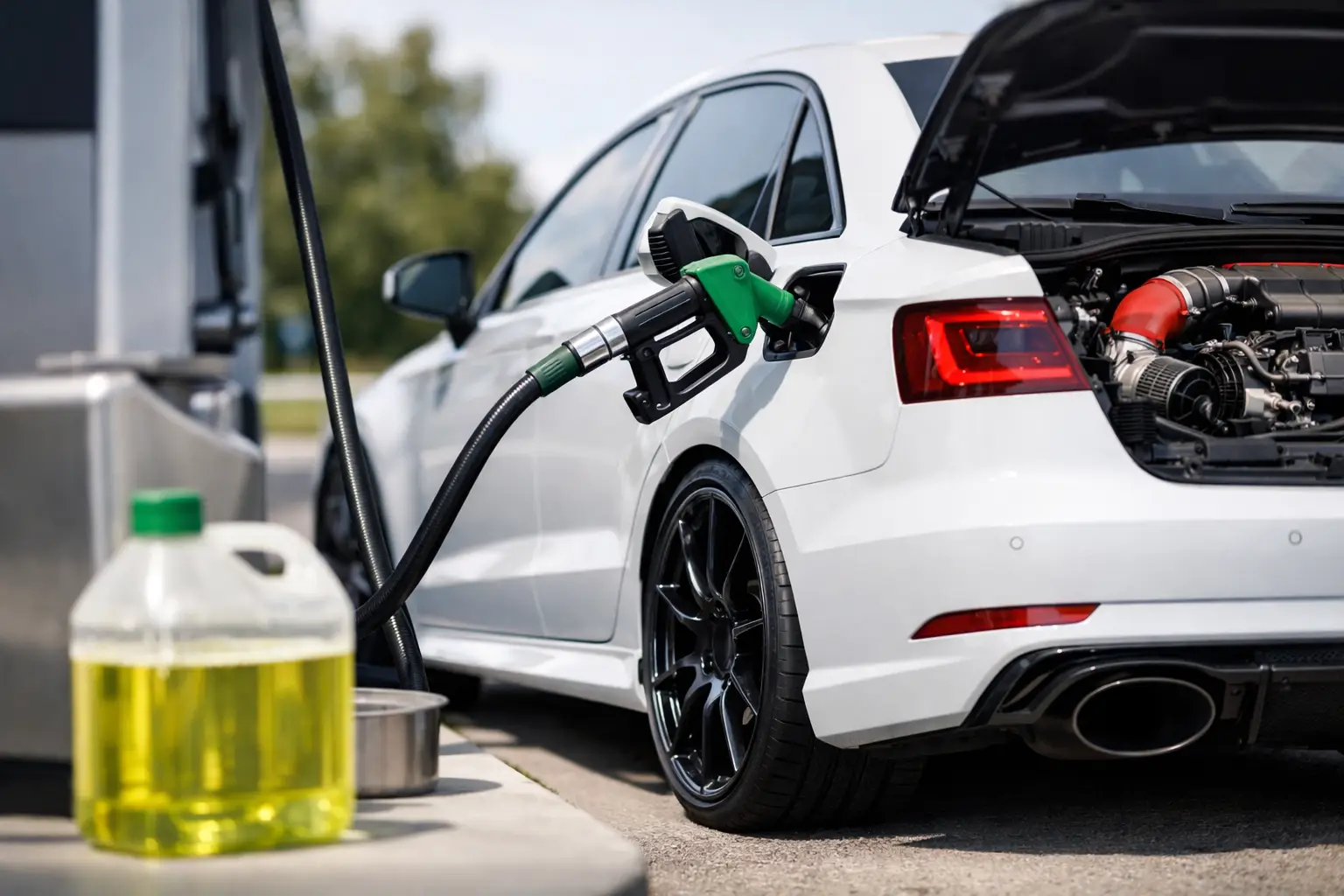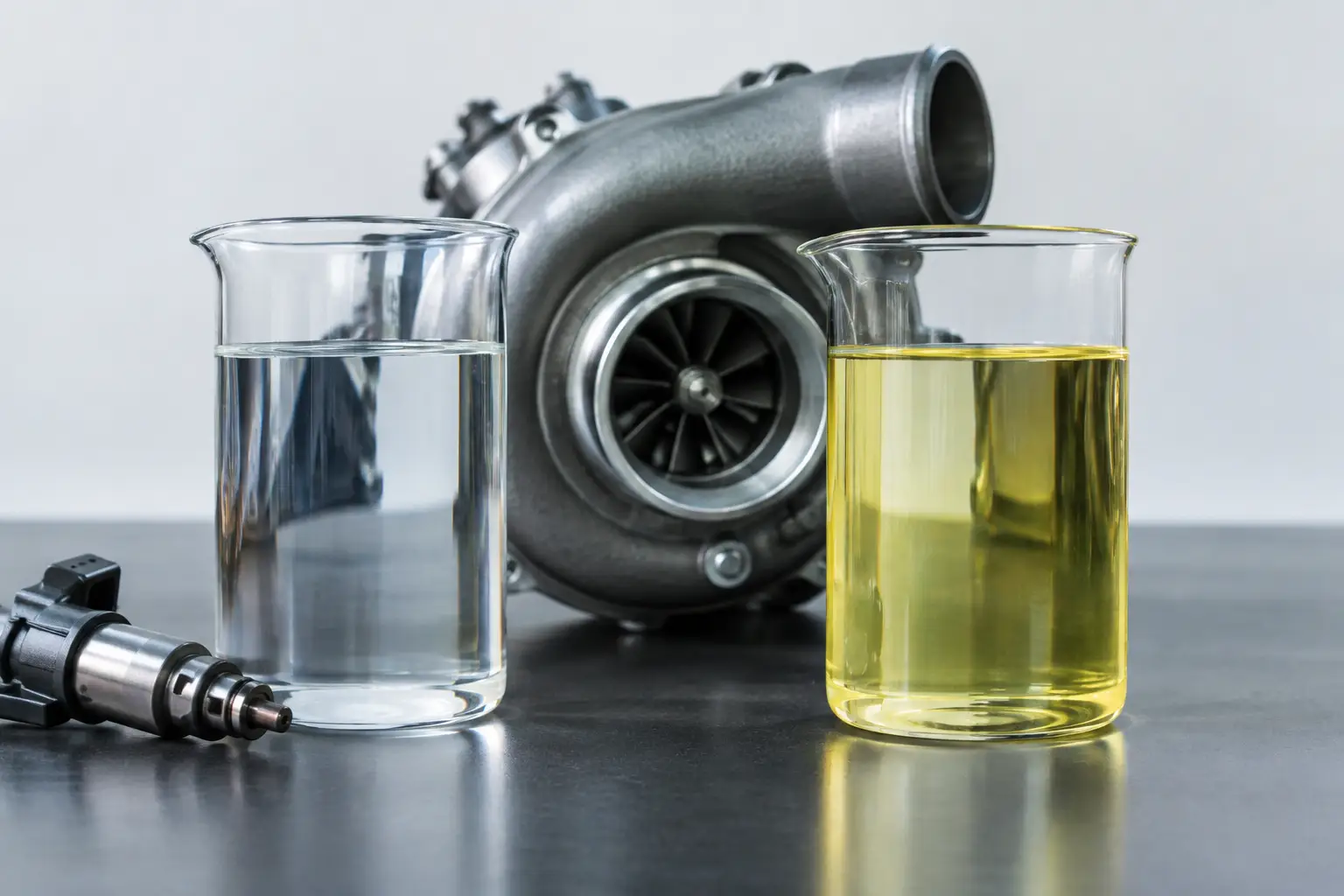
A 700whp EA855, S58, or MQB build can make either strategy look tempting, but water methanol versus ethanol is not a simple choice between two fuels. Water-methanol injection is an auxiliary charge-cooling and octane-support system. Ethanol is the primary fuel in the tank, changing the engine’s knock resistance and fuel-volume requirements every time the car runs. The right answer depends on the car’s intended use, existing fuel system, tuning support, and how much risk you are willing to manage.
For a street-driven turbo platform, ethanol is usually the more complete path to repeatable power when the supporting hardware is sized correctly. Water-methanol can be extremely effective, particularly where ethanol availability is limited or intake temperatures are the limiting factor, but it adds another system that must work perfectly when the calibration expects it.
Water Methanol Versus Ethanol: The Core Difference
Ethanol blends such as E30, E50, E60, and E85 are burned through the factory or upgraded fuel system. Ethanol has a high effective octane rating and significant charge-cooling potential as it vaporizes in the intake tract and cylinder. That allows a calibrator to command more boost, ignition timing, or both while maintaining a safer knock margin than conventional pump gas provides.
Water-methanol injection sprays a mixture, commonly 50/50 water and methanol, into the charge pipe or intake manifold under boost. The water portion absorbs heat exceptionally well. Methanol contributes combustible energy and octane support. Together, they can sharply reduce intake air temperature after the intercooler and suppress knock in conditions where a pump-gas tune would otherwise need to pull timing.
That distinction matters. Ethanol is part of every combustion event because it is in the tank. Water-methanol is delivered only when the injection system commands it, generally under load and boost. If an ethanol blend varies slightly, a properly configured flex-fuel calibration can compensate. If a water-methanol pump loses prime, a line leaks, a nozzle clogs, or the reservoir runs dry, an aggressive meth-dependent calibration can become unsafe very quickly.
Why Ethanol Is the Foundation for Repeatable Power
On modern European turbo engines, ethanol is often the first serious fueling upgrade because it improves knock resistance throughout the operating range. An ethanol blend can support stronger torque through the midrange as well as more stable power at high rpm. It also does not depend on a separate reservoir, injection nozzle, pump, solenoid, and failsafe strategy.
The compromise is fuel volume. Ethanol contains less energy per gallon than gasoline, so the engine needs substantially more fuel to make the same power. Factory low-pressure and high-pressure fuel systems can become the limiting factor well before the turbo, intercooler, or engine internals do. That is why high-output applications often require upgraded in-tank pumps, low-pressure fuel pumps, high-pressure pumps, port injection, larger injectors, or supplemental fueling systems.
For example, an E30 tune may be realistic on a lightly modified BMW B58 or VW/Audi EA888 with the right calibration and fuel-quality checks. A true E85 setup at substantially higher output may require a complete fueling plan. On an RS3/TTRS DAZA or DNWA build targeting four-figure crank horsepower, ethanol capability is not just a tune file selection. It is a system decision involving pumps, injectors, lines, sensors, controller capacity, and the tuner’s proven hardware combination.
Ethanol quality also deserves respect. Pump E85 is not always 85 percent ethanol, particularly in colder regions where seasonal blends can contain considerably less. An ethanol-content sensor and flex-fuel calibration remove much of the guesswork. Without them, testing the blend and mixing deliberately are part of responsible ownership.
Ethanol’s street-car advantage
For a car that sees regular miles, ethanol is generally easier to live with once the fuel system is built around it. There is no auxiliary tank to fill and no injection hardware that can silently fail under boost. The practical limitation is access: if quality ethanol is difficult to find on your routes, a high-ethanol tune can turn a simple weekend drive into a fuel-planning exercise.
Fuel consumption will also increase. That is normal, not a tuning problem. Drivers should expect shorter range, especially on high-output cars that already use substantial fuel under boost.
Where Water-Methanol Injection Makes Sense
Water-methanol injection earns its place when intake-air temperature control and knock suppression are the immediate goals. It can be especially useful on pump-gas builds in hot climates, road-course cars dealing with heat soak, or vehicles where ethanol is unavailable or inconsistent. A well-designed system with a properly sized nozzle can produce a meaningful reduction in charge temperature and help a tuner retain power under conditions that challenge an intercooler alone.
It can also complement ethanol rather than compete with it. On an ethanol-fueled high-boost build, water-methanol may provide additional thermal control during repeated pulls or extended track use. In that role, it should be viewed as supplemental protection and performance support, not an excuse to skip adequate intercooling, fueling capacity, or conservative calibration practices.
The installation details matter more than many buyers expect. Nozzle location affects distribution. Line routing affects reliability. Tank placement affects serviceability. Check valves, filters, fluid-level monitoring, pressure verification, and a true failsafe are not optional details on a vehicle tuned to depend on injection. A basic low-level light is better than nothing, but it does not verify actual flow under pressure.
A worthwhile failsafe can reduce boost, switch maps, close the throttle through an appropriate control strategy, or otherwise move the engine to a safe operating condition if injection flow falls outside the expected range. The exact solution depends on the ECU, tuning platform, and vehicle. What matters is that the engine does not continue making meth-dependent boost and timing when the system is not delivering fluid.
The water-methanol trade-off
Water-methanol is powerful, but it demands disciplined maintenance. Reservoirs need filling. Mixture concentration needs to remain consistent. Filters and nozzles need inspection. Methanol is toxic and flammable, so fluid handling and storage deserve the same care you would give any performance fuel.
There is also an important tuning question: Is the car optimized for injection, or merely safer and cooler when injection is active? A pump-gas calibration that uses water-methanol as a buffer has a much lower consequence of failure than a calibration that requires it to prevent detonation. Serious builds should make that distinction explicit before the first full-throttle pull.
Choosing for Your Platform and Power Goal
Start with the fuel you can obtain consistently. If reliable E85 or a known ethanol blend is readily available, ethanol usually offers the cleaner route to dependable street and drag-strip power. Build the fuel system for the actual ethanol content and power target, not the number you hope to reach later.
If ethanol access is poor, a water-methanol system can make premium pump gas far more capable. That can be a smart solution for a street car that only sees occasional hard use, provided the calibration includes appropriate safety measures. It is not a substitute for a larger intercooler on a heat-soaked MQB car, a weak low-pressure fuel supply on an S58, or undersized injectors on a big-turbo setup.
For track use, examine the duty cycle. Repeated laps create a different thermal and fluid-demand problem than a single quarter-mile pass. Ethanol reduces knock sensitivity at every load point, while water-methanol adds valuable charge cooling but consumes reservoir volume quickly when the engine spends long periods in boost. A setup that is excellent for a 10-second pass may be inconvenient or insufficient for a 20-minute session.
Work with hardware and calibration that are proven for your exact engine code, turbocharger, and output target. This is where fitment accuracy matters as much as the headline horsepower number. A premium pump, sensor, controller, or injection kit only performs as intended when the complete combination is matched correctly.
A Better Way to Make the Decision
Choose ethanol when you want the most consistent all-around power potential and can support it with adequate fueling hardware and dependable fuel access. Choose water-methanol when you need additional charge cooling, have limited ethanol availability, or want a supplemental system for a specific high-heat application. Use both only when the build’s goals justify the added complexity and the tune has been designed around it.
The fastest parts list is not always the strongest one. Build around the fuel you can supply, the temperatures your car will actually see, and the safeguards you will maintain. That approach produces the kind of power you can use repeatedly, rather than a dyno number that only works under perfect conditions.