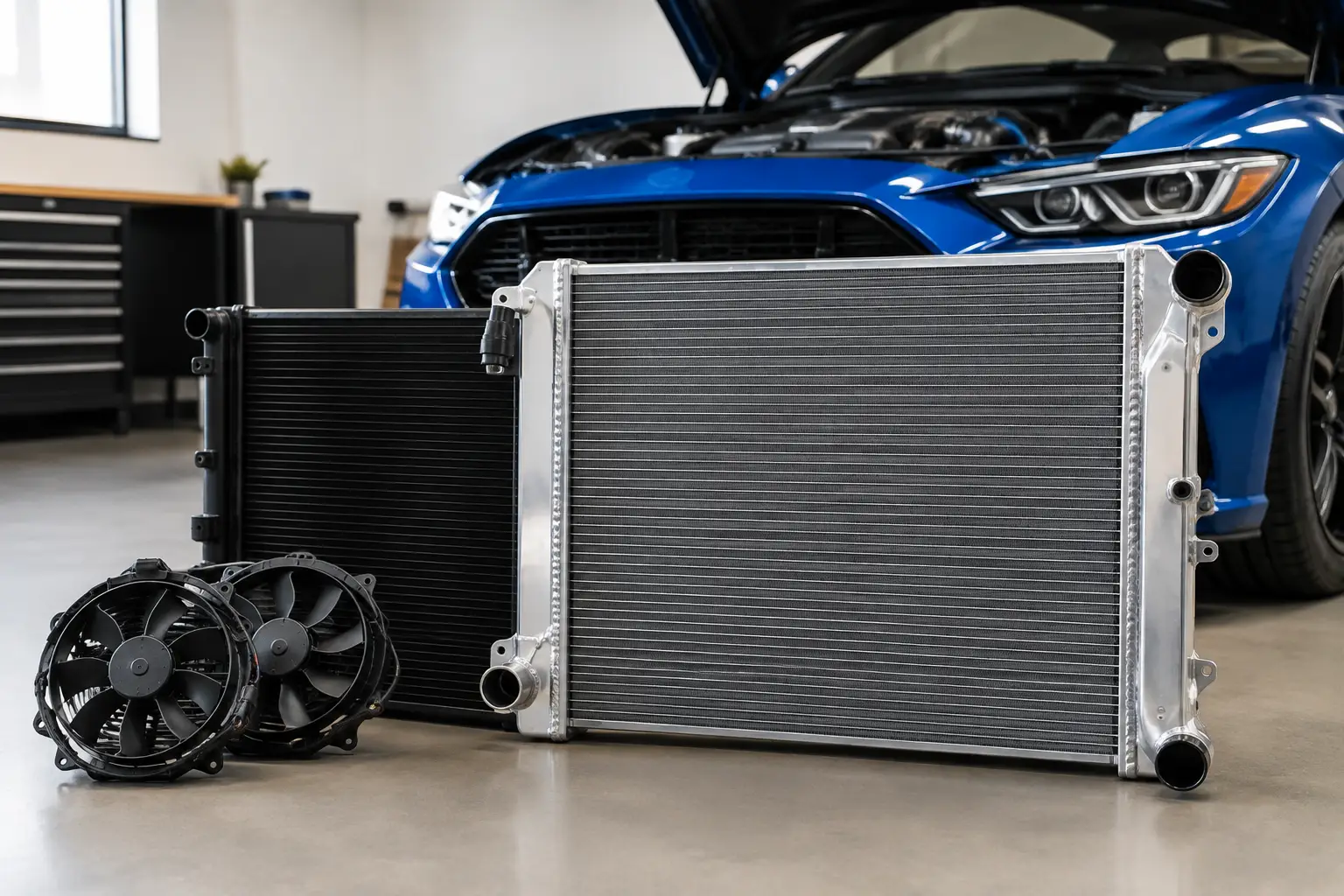
A temperature gauge that climbs only after a few hard pulls is rarely asking for a bigger radiator alone. It is telling you the cooling system has reached its heat-rejection limit. Knowing how to upgrade radiator capacity correctly means matching the core, airflow, plumbing, and supporting heat exchangers to how your European performance car is actually driven.
For a lightly modified daily-driven GTI, S3, M3, or AMG, the right upgrade may be a direct-fit aluminum radiator with improved core efficiency. For a road-course car, repeated boost events, high ambient temperatures, and reduced front-end airflow can demand a more complete cooling package. The goal is stable operating temperature under sustained load, not simply the largest radiator that fits behind the bumper.
Start With the Reason Your Car Runs Hot
Before ordering parts, identify when the temperature rises. If coolant temperature climbs in traffic but settles at highway speed, airflow at low vehicle speed is the likely issue. Fan operation, fan shrouding, condenser blockage, and the condition of the factory fan control system deserve attention before assuming the radiator is undersized.
If temperatures rise during long pulls, track sessions, or steep grades and stay elevated even at speed, the radiator may not have enough effective surface area or core volume for the heat load. This is common once boost, ignition timing, fueling, or power output has moved well beyond factory calibration. A 700-horsepower S58 or 2.5TFSI build produces substantially more waste heat than the cooling system was designed to manage in stock form.
Also separate coolant temperature from oil temperature, intake air temperature, and transmission temperature. A larger engine radiator will not cure heat-soaked charge air or an overloaded dual-clutch transmission. On many turbocharged European platforms, the radiator, intercooler circuit, oil cooler, and air-conditioning condenser compete for the same frontal airflow. The weakest system can set the limit.
Choose the Right Radiator Upgrade
A quality performance radiator improves cooling through core design, capacity, and construction. It should not be chosen by advertised thickness alone. A thicker core can hold more coolant and present more fin area, but only if air can pass through it efficiently. An overly dense or excessively thick core can restrict airflow at low speed, particularly with a factory fan package that was not designed around it.
Core Size and Fin Efficiency
Look for a radiator engineered for your exact chassis and engine configuration. Direct-fit units maintain proper mounting points, hose routing, sensor provisions, and clearance for factory or upgraded fans. This matters on tightly packaged platforms such as MQB Volkswagens and Audis, BMW G8X models, and late-model Mercedes performance applications.
Core thickness, tube design, and fin spacing work together. Larger tubes can move coolant with less restriction, while a well-designed fin pack transfers heat into the airflow. Premium aluminum radiators often use brazed construction and stronger end tanks to handle sustained thermal cycling and system pressure better than aging factory plastic-tank radiators.
More capacity is useful, but it is not automatically better. A street car in a cold climate may take longer to reach ideal operating temperature with an oversized cooling system. That is usually manageable with a functioning thermostat, but it reinforces the point: select the radiator for the car’s duty cycle, not for a catalog specification alone.
Fitment Is a Performance Requirement
Verify the vehicle year, chassis code, engine code, transmission, and any factory auxiliary coolers before buying. A radiator for an Audi RS3 may differ from one for a lower-output A3 despite similar external dimensions. On BMW applications, manual and automatic configurations can have different cooling connections. Cars fitted with upgraded intercooler piping, front-mount heat exchangers, or aftermarket turbo kits may introduce clearance issues that do not exist on a stock vehicle.
If your build uses an auxiliary radiator or low-temperature intercooler circuit, confirm whether the selected part replaces the main engine radiator or one of the supplemental heat exchangers. Ordering the correct component is more valuable than forcing a universal radiator into a premium performance build.
Airflow Matters as Much as Coolant Capacity
The radiator only works when air moves through it. Debris trapped between the condenser and radiator can severely reduce heat transfer, especially on cars that see street miles, track days, or dusty driving conditions. Inspect the entire cooling stack before installation and clean it carefully from the appropriate side.
A properly fitted fan shroud is equally important. The shroud forces the fan to pull air through the whole radiator core rather than the small area directly behind the blades. Retain the factory shroud when compatible, or use a purpose-built shrouded fan solution. Universal slim fans can create clearance, wiring, and airflow compromises if installed without a complete plan.
Pay attention to everything mounted in front of the radiator. A large front-mount intercooler, auxiliary cooler, grille insert, or bumper duct can improve one system while reducing airflow to another. This does not mean avoiding supporting upgrades. It means building the cooling package as a system. A track-focused turbo car may need improved ducting and extraction as much as it needs a larger core.
Supporting Parts Worth Replacing During Installation
Radiator work exposes components that are difficult to reach later. If the vehicle has significant mileage or will be used hard, this is the right time to inspect the thermostat, water pump, expansion tank, cap, hoses, quick-connect fittings, and fan connectors. A new radiator cannot overcome a thermostat that opens late, a weak water pump, or a pressure cap that vents before the system reaches its intended operating pressure.
Use the coolant formulation specified for the vehicle and mix it with distilled water at the appropriate ratio for your climate and use case. More water can improve heat transfer for dedicated warm-weather track use, but it reduces freeze protection and may not meet the needs of a street-driven car. Never mix coolant types blindly because the color is similar.
For high-output builds, consider whether the oil cooler, charge-cooler heat exchanger, and transmission cooler are appropriately sized. EAS Store supports cooling upgrades across serious European performance applications, but the correct package always depends on the power target, climate, and driving environment.
How to Upgrade a Radiator Without Creating New Problems
Installation quality determines whether the upgrade performs as intended. Work only on a fully cold engine, relieve system pressure carefully, and capture old coolant for proper disposal. Remove surrounding trim, intake components, fans, and ducting methodically so every mounting point and connector goes back where it belongs.
Test-fit the radiator before final assembly. Check that it sits squarely in its mounts, does not contact the condenser or intercooler piping, and allows the fan shroud to seat fully. Inspect hose connections for damaged O-rings, distorted retaining clips, and worn plastic fittings. Reusing a questionable quick-connect can turn a straightforward upgrade into a coolant leak at the next track event.
Once filled, bleed the cooling system using the factory procedure for your platform. Many modern BMW, Audi, Volkswagen, and Mercedes vehicles require a specific electronic bleed routine or heater setting to purge trapped air. An air pocket can cause erratic temperatures, poor cabin heat, coolant warnings, and localized hot spots even with a new radiator installed.
After the first heat cycle, allow the engine to cool completely and recheck coolant level, clamps, fittings, and drain points. Then validate the repair under the conditions that exposed the problem. A brief idle in the driveway is not a useful test for a car that overheated after twenty minutes of sustained boost.
When a Bigger Radiator Is Not the Answer
If coolant temperatures are stable but oil temperature continues to climb, prioritize oil cooling. If the engine pulls timing because intake air temperatures stay high, improve the intercooler system or low-temperature cooling circuit. If the car overheats only at low speed, diagnose fan command, relays, modules, and airflow before adding capacity.
A radiator upgrade is most effective when it solves a measured limitation. Log coolant temperature, oil temperature, intake air temperature, ambient temperature, vehicle speed, and fan behavior whenever possible. Those data points turn a parts guess into a cooling strategy.
Build for the hardest session your car will see, not the easy drive it handles today. When the radiator, airflow path, and supporting heat exchangers are matched to the power level, your next full-throttle lap can be about braking points and exit speed rather than watching the temperature gauge.