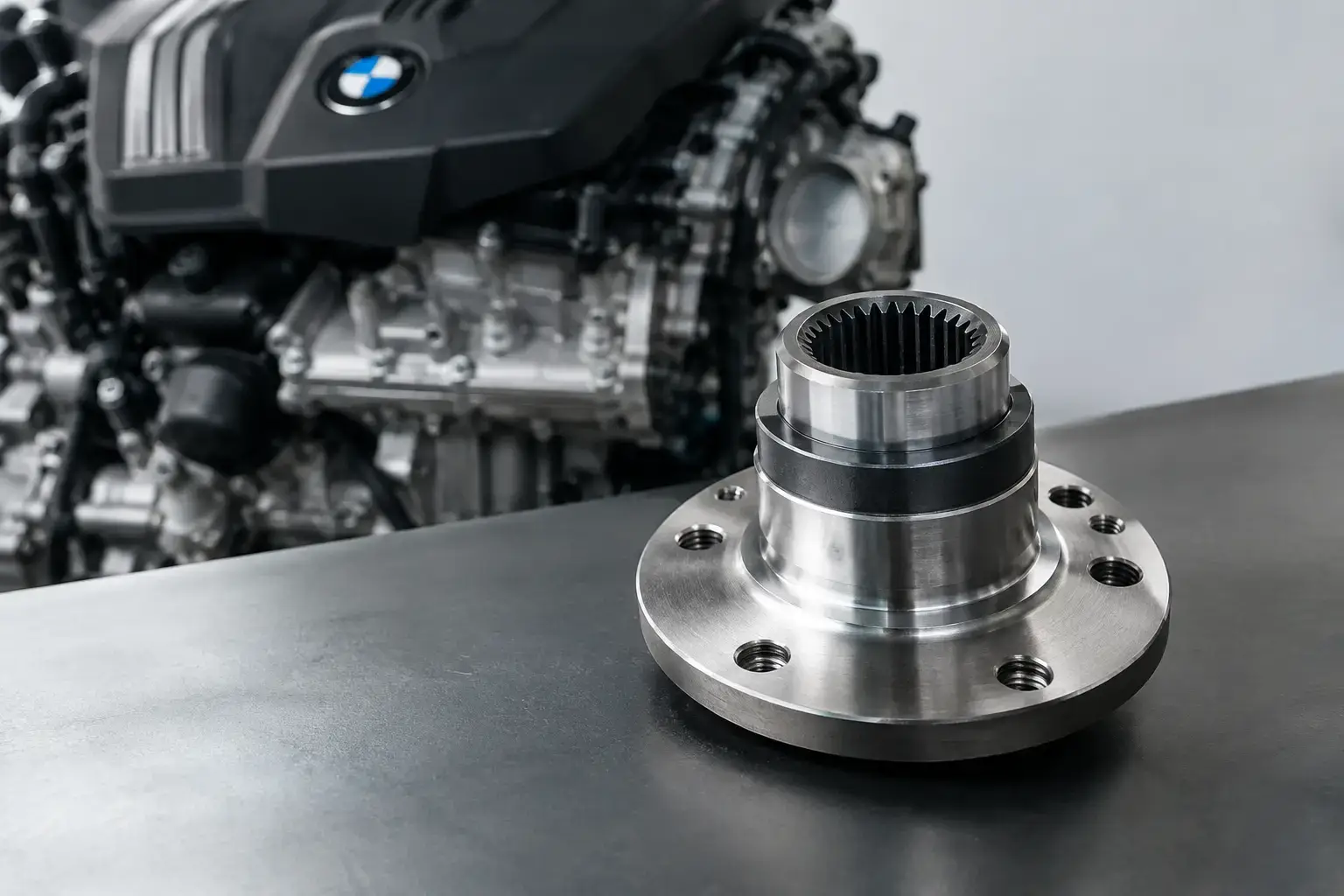
A BMW N55 crank hub is not the first part most owners think about when planning a build. The usual shopping list starts with a downpipe, intake, intercooler, charge pipe, and tune. But when torque rises and the engine is repeatedly loaded hard, crankshaft-to-cam timing becomes a reliability conversation, not just an engine-bay detail.
The N55 is a capable turbocharged inline-six with a deep aftermarket and a strong record in street and track applications. Still, its factory crank hub design has earned attention from tuned-car owners for one reason: if the hub slips, cam timing can move out of its intended position. The result can range from a warning light and reduced power to serious internal engine damage. Knowing when the risk is real, and which upgrade makes sense for your build, helps avoid spending money in the wrong place.
What the BMW N55 Crank Hub Does
The crank hub connects the crankshaft to the components that drive engine timing. Its job is to maintain a fixed relationship between crankshaft rotation and the timing system that controls the camshafts. At factory output, with factory calibration and normal use, the OE assembly is designed to do that job.
The concern begins when the friction-based interface is subjected to conditions beyond the original engineering target. Higher boost, more aggressive ignition and torque targets, hard launches, high-rpm shifts, repeated roll-racing pulls, and track use can all increase the shock load placed on the assembly. A sudden torque event can be more relevant than a peak dyno number alone.
If the hub rotates relative to where it should be, valve timing can shift. Modern BMW engine management may detect a cam/crank correlation issue, but electronics cannot reverse a mechanical timing change. That is why a crank hub upgrade is often viewed as preventative insurance on a serious N55 build.
Is an N55 Crank Hub Upgrade Necessary?
There is no honest universal horsepower number where every N55 must receive a crank hub upgrade. Plenty of lightly tuned daily drivers operate without issue, while some aggressively used cars may see trouble at power levels that sound modest on paper. The right answer depends on torque delivery, driving style, tuning quality, engine condition, and how much financial risk the owner is willing to accept.
For a stock car or a conservative Stage 1 setup used primarily for commuting, the factory hub may remain a reasonable choice. Regular maintenance, quality calibration, and avoiding abusive cold pulls still matter. A crank hub upgrade may be lower on the priority list than cooling, charge-pipe reliability, tires, brakes, or resolving existing maintenance needs.
The equation changes with ethanol blends, upgraded turbos, aggressive custom tuning, drag-strip launches, road-course sessions, and frequent high-load driving. These builds commonly generate torque quickly and repeatedly. Owners targeting high-output street performance or building a car they cannot afford to have sidelined should consider addressing the crank hub before pushing the calibration further.
A shop-built engine is another clear opportunity. When the engine is already apart for forged internals, head work, or major service, installing an upgraded hub is far more sensible than paying for front-end labor twice later.
How Crank Hub Slip Can Show Up
A slipped hub does not always announce itself with a dramatic failure. In some cases, the first sign is a check-engine light accompanied by drivetrain or reduced-power messages. Diagnostic faults may point to camshaft timing, VANOS plausibility, or crankshaft/camshaft correlation. Rough running, difficult starts, unusual idle behavior, or a sudden change in power delivery can also appear.
Those symptoms do not automatically prove the crank hub has slipped. VANOS solenoids, cam sensors, wiring issues, timing-chain wear, oil-pressure concerns, and tune-related problems can create similar fault patterns. Treat diagnosis as diagnosis. Pull fault codes, inspect the data, and have a BMW-experienced technician verify mechanical timing rather than ordering parts based on a forum screenshot.
Do not keep making full-load pulls if a timing-related fault appears. Continuing to drive a car with questionable valve timing can turn a repairable issue into contact between valves and pistons. Towing the vehicle and inspecting it properly is the lower-cost decision.
Choosing the Right BMW N55 Crank Hub Solution
Aftermarket solutions generally focus on preventing the hub from rotating relative to the crankshaft. The most common approaches use a pinned design, a keyed design, or a one-piece upgraded hub. Each can be effective when engineered correctly and installed with the right tooling.
Pinned hubs add physical locating points between the hub and crankshaft. Their appeal is straightforward: pins are intended to resist the rotational movement that a friction-only arrangement can allow. The trade-off is that installation requires precise drilling and indexing. The work must be done accurately, with proper fixtures and a technician who understands the platform.
Keyed or keyed one-piece options create a more positive mechanical connection. Many serious builders prefer these designs for high-torque applications because they are intended to eliminate reliance on the factory-style friction interface. The trade-off is similar: this is not a casual driveway project, and part selection must match the exact N55 application and intended use.
A crank bolt capture solution serves a different purpose. It is designed to help retain crank bolt clamping force, but it does not necessarily create the same positive mechanical lock as a pinned or keyed hub. It can be a useful component in a broader reliability plan, but it should not be purchased under the assumption that every capture plate solves every hub-slip scenario.
Material quality, machining accuracy, supplied hardware, installation instructions, and manufacturer support matter here. This part lives at the center of the engine’s timing system. A bargain component with vague application data is not the place to save a few dollars.
Match the Part to the Build, Not the Hype
A 500-wheel-horsepower street car on a measured calibration has different demands than a high-boost ethanol car that sees drag launches every weekend. The second car benefits from the most positive, proven solution available for its application. The first may still benefit from an upgrade, but the decision should account for budget, labor, and the rest of the vehicle’s reliability plan.
Also confirm the engine and chassis before ordering. BMW’s N55 appeared across multiple chassis and production years, and surrounding components, access, and service requirements can vary. Give your supplier the VIN, model year, transmission, power goal, current modifications, and intended fuel. Compatibility support is especially valuable when a build includes an upgraded turbo, port injection, or a calibration built around ethanol.
Installation Is Where Reliability Is Won
Crank hub installation requires more than removing the front of the engine and fitting a new part. Proper timing tools are needed to lock and verify the engine position. The installer must follow the manufacturer-specific procedure, use the correct torque-and-angle sequence, and replace one-time-use hardware where required. A new front crank seal is often sensible while access is available.
Before reassembly, inspect related components. Timing chains, guides, sprockets, oil leaks, accessory-drive parts, and front-main-seal condition should all be evaluated. If the car has a history of timing faults or visible debris in the oil, the job may need to expand beyond a hub replacement. Installing an upgraded hub without confirming the engine’s mechanical condition can create false confidence.
After installation, verify timing mechanically and electronically. The car should be scanned for faults, allowed to reach operating temperature, and tested progressively before any full-load use. A proper installer documents the work and is prepared to explain the parts used, timing procedure, and break-in or follow-up recommendations.
Supporting Upgrades Worth Considering
A crank hub is one piece of an N55 reliability strategy. On tuned cars, charge-pipe upgrades, effective intercooling, fresh spark plugs with the correct gap, healthy ignition coils, proper fueling capacity, and frequent oil service all deserve attention. For cars that see repeated hard use, cooling capacity and transmission maintenance can be just as critical as the engine hardware.
The calibration matters as much as the parts list. A quality tune manages boost, ignition timing, fuel pressure, and torque delivery with the actual hardware and fuel in mind. An aggressive file that chases a headline dyno number can put unnecessary stress on every component downstream of the crankshaft. Conservative power delivery is not a compromise when the goal is to enjoy the car for years.
EAS Store can help enthusiasts and specialty shops narrow down a crank hub solution based on the exact N55 configuration rather than selling a generic answer for every BMW build.
Common Questions About the N55 Crank Hub
Can a stock N55 crank hub slip?
Yes, although risk generally rises with modified torque output and severe use. Stock power does not guarantee immunity, but it does not mean every stock N55 needs immediate crank hub work either.
Does a crank hub upgrade add horsepower?
No. It is a reliability upgrade, not a power adder. Its value is maintaining correct mechanical timing when the engine is exposed to higher loads.
Can I install a crank hub myself?
Experienced engine builders with the required BMW timing tools, fixtures, and procedure knowledge may do the work. For most owners, this is a job for a qualified BMW performance shop. Installation quality is inseparable from the part’s effectiveness.
Build the N55 in the same order you plan to use it. If full-throttle ethanol pulls, track sessions, or high-torque launches are part of the plan, make the crank hub decision before the tune becomes the most expensive part of the project.