
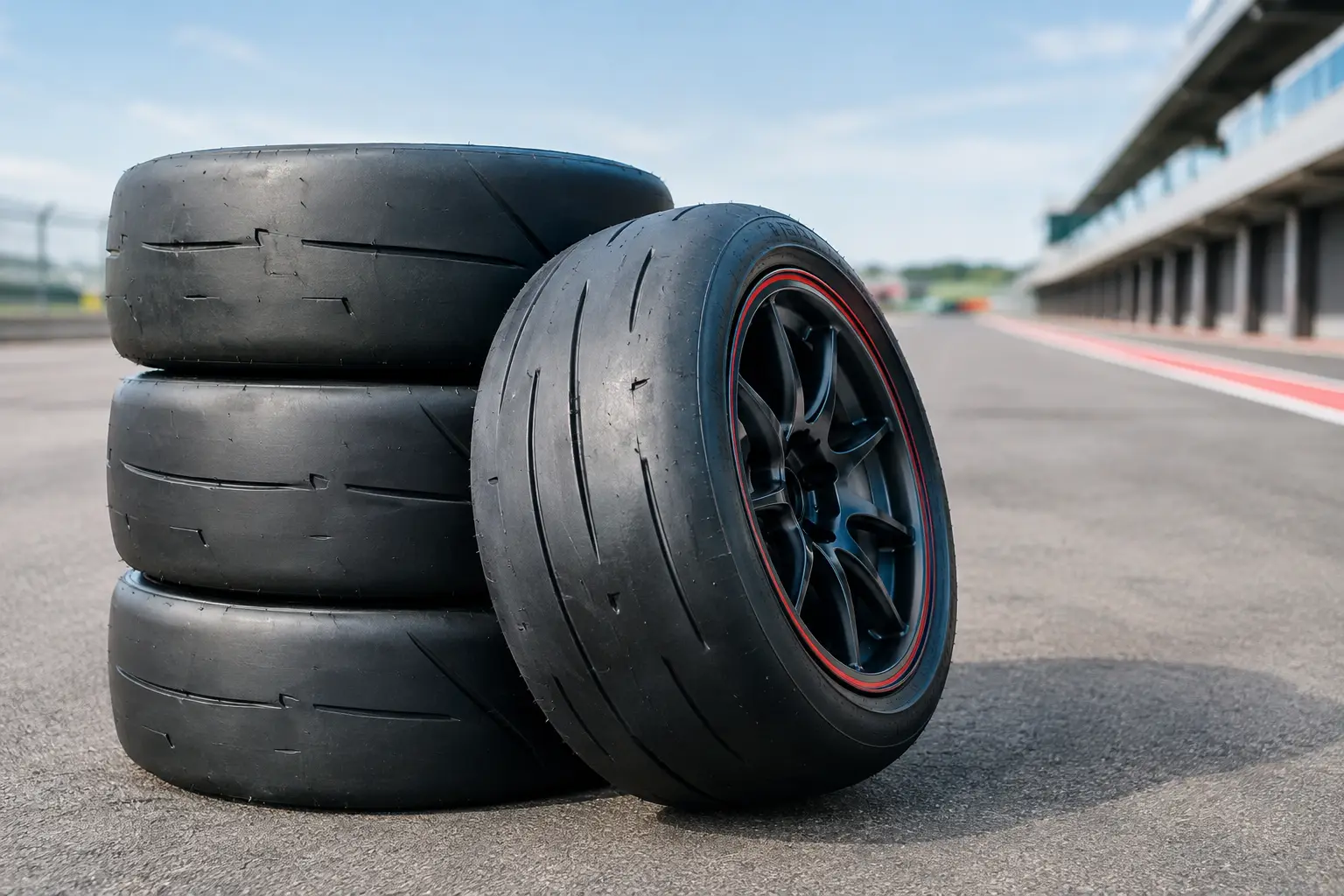
A car can gain more lap time from the right tire than from another round of bolt-on power. The best track tires put the available grip to work predictably, survive the heat your pace creates, and match the chassis, alignment, brake package, and conditions at your event. Pick the wrong set and even a well-built Audi RS3, BMW M car, or tuned MQB platform can feel vague, nervous, or slow after only a few hard laps.
The first rule is simple: there is no universal winner. A 200-treadwear tire that dominates a dry time-attack session may be a poor choice for a driver who needs to run in rain, drive several hours home, or complete long 20- to 30-minute sessions without managing heat. Start with your actual use case, then choose the tire around it.
What Makes the Best Track Tires?
A track tire has to do more than produce one fast flyer. It needs to communicate when the front axle is nearing its limit, keep the rear stable under power, and recover after repeated braking and cornering loads. That balance matters more than a single advertised grip number.
For most dual-duty performance cars, 200-treadwear extreme-performance summer tires are the sweet spot. They offer substantially more dry grip and steering precision than a standard max-performance street tire while remaining usable for track days, autocross, and limited street mileage. They are also legal in many grassroots competition classes.
Dedicated competition tires, including DOT competition compounds and full slicks where permitted, can deliver another level of outright pace. The trade-off is a narrower operating window. They typically require more temperature, more camber, closer pressure management, and more disciplined heat cycling. They can also become expensive quickly when the car is heavy, high-powered, or poorly aligned.
The best choice is the tire that remains consistent at your normal pace, not the one that feels incredible for two laps before it overheats.
Start With Your Track-Day Goal
Before comparing brands or tread patterns, decide what a successful tire needs to do for your car. A street-driven GTI or S3 running a first track day has different needs than an 800-horsepower G8X BMW built for time attack.
Street and track use
If the car sees regular road miles, prioritize wet behavior, reasonable cold performance, and a tire that does not punish you for missing a pressure target by 1 psi. A quality 200-treadwear tire with usable grooves is the sensible answer. You give up some peak grip compared with a near-slick, but gain confidence in variable weather and fewer compromises on the drive to and from the circuit.
Track days and HPDE
For repeated lapping, heat tolerance should move to the top of the list. Heavy cars and turbocharged cars with strong midrange torque place serious demand on the outer shoulders and rear tires. Look for a compound known to stay stable over longer sessions, then support it with enough negative camber, brake cooling, and pressure adjustment.
Time attack, autocross, and qualifying laps
If the objective is a short, aggressive session, a faster-wearing 200-treadwear tire or competition-oriented DOT tire may make sense. These tires often respond well to a precise setup and can produce exceptional initial grip. They are less forgiving when temperatures spike, rain arrives, or the car is asked to run session after session at the same pace.
Dedicated race cars
Slicks and race compounds belong here when the suspension, alignment, wheel package, and tire-management process are ready for them. More grip increases load everywhere. Braking zones shorten, corner speeds rise, and the car may need spring, damping, aero, and differential adjustments to use the tire properly. Do not treat slicks as a standalone upgrade.
Compound and Temperature Matter More Than Marketing
Treadwear ratings are helpful for class rules, but they are not a direct grip scale. Two tires with a 200 rating can behave very differently. One may come in quickly and offer a sharp, aggressive front end, while another may need a lap to build temperature but remain stable deeper into a session.
Pay attention to the track surface and ambient conditions you normally see. A cooler, smooth circuit can reward a softer compound that reaches its operating range quickly. A hot, abrasive track can destroy a soft tire, especially on a front-heavy all-wheel-drive platform. The correct tire is always tied to heat management.
This is where driver feedback matters. If grip falls away after several laps and the tire feels greasy, the issue may be excessive pressure, insufficient camber, too much sliding, or a compound that cannot support the session length. Do not assume more expensive automatically means better for your car.
Choose Size for the Whole Package, Not Just Width
A wider tire can increase the contact patch, but only if the wheel width supports it and the car can maintain clearance through steering lock and suspension compression. Mounting a very wide tire on a narrow wheel can dull steering response and overwork the tread. On the other hand, moving to a properly sized wider wheel and tire package can improve support, stability, and thermal capacity.
Diameter matters as well. Changing overall tire diameter affects gearing, wheel speed calculations, ride height, and clearance. On vehicles with advanced stability systems or all-wheel-drive hardware, keeping rolling diameter close between all four corners is especially important.
Square setups are popular for track-focused BMW and Volkswagen/Audi applications because they allow tire rotation and can reduce understeer by adding front width. A staggered setup can still be the right solution for cars that need more rear traction or have wheel-well limitations. There is no advantage in copying another owner’s fitment without checking your specific brakes, suspension, fenders, and alignment range.
Alignment Is Part of the Tire Purchase
Track tires cannot compensate for an alignment built only for commuting. Under cornering load, the outside tire rolls onto its shoulder. Without sufficient negative camber, the outer edge overheats, wears quickly, and loses grip long before the tread is gone.
Performance alignment settings should be based on the tire, vehicle weight, suspension design, and intended use. More negative camber can preserve shoulders and improve front-end bite, but excessive camber can reduce braking performance and accelerate inside wear on the street. Toe settings also matter. Small changes can sharpen turn-in or improve stability, but too much toe creates drag and heat.
After each event, inspect the shoulders, tread surface, and wear pattern. Uneven wear is useful information. It can point to an alignment issue, pressure problem, insufficient wheel support, or driving style that is asking too much from one end of the car.
Pressure Management Separates Fast Tires From Wasted Tires
Cold pressure is only a starting point. What matters is the tire’s hot pressure and its temperature distribution across the tread after a hard session. The exact target varies by tire construction and vehicle, so use the manufacturer’s guidance as a baseline and record your own results.
Start with conservative cold pressures, come in after several representative laps, and check the tires immediately. If the car pushes as the session progresses and the shoulders look abused, the front tire may be rolling over or overheating. If the car feels loose under power, inspect rear pressures and temperatures before blaming the chassis.
A basic track notebook is one of the highest-value tools in the paddock. Record ambient temperature, cold pressure, hot pressure, session length, alignment, and driver comments. Over several events, those notes will show you when the tire is truly working and when a setup change is needed.
Wet Weather Changes the Answer
A fast dry tire with minimal tread can be dangerous in standing water. If rain is possible, choose a tire with enough void area to evacuate water, or bring a separate wet-capable set if your budget and transport allow it. Even a good wet tire will not overcome poor judgment. Reduce speed, avoid deep puddles, and give the car room to move.
For drivers who attend events regardless of forecast, a second wheel set is often smarter than trying to force one tire to cover every condition. It protects your dry set, gives you a safer option when weather turns, and makes tire changes faster at the track.
Build the Tire Package Around the Car
The right tire decision includes wheels, alignment hardware, brake fluid, pads, cooling, and suspension condition. A high-grip tire reveals weak links quickly. Worn control-arm bushings, marginal brake pads, and inadequate cooling become more obvious once corner speeds increase.
EAS Store supports performance builds with the platform-specific focus serious European-car owners need, whether you are refining a dual-duty street car or specifying components for a dedicated track setup. Confirm wheel and brake clearance, load rating, and fitment before ordering, especially when moving to a larger rotor package or aggressive offset.
The fastest tire choice is rarely the most extreme one on the shelf. Choose a set that matches your pace, lets you learn the car, and delivers repeatable feedback from the first session to the checker. When the tire, setup, and driver are working together, the lap time follows.


