A fast lap can feel brilliant and still leave questions unanswered. Did the car gain time because it carried more minimum speed, or because the driver released the brake earlier? Is the rear axle moving around from tire temperature, damper control, or throttle application? A race car data logging guide gives performance drivers a repeatable way to answer those questions with evidence instead of guesswork.
For track-focused European platforms, data is particularly valuable once power, brakes, suspension, and tires begin working closer to their limits. An Audi RS3, BMW G8X, or MQB car with serious cooling and fueling upgrades can make enough power to hide a poor corner exit. Logging separates driver technique from mechanical limitations so each change has a purpose.
Start With a Clear Logging Goal
The best data session starts before the car rolls out of the paddock. Pick one objective for the day: improve consistency through a braking zone, validate coolant control during a hot session, compare two tire pressures, or confirm that fuel pressure stays stable at full load. Trying to evaluate every system and every driving habit at once produces a screen full of traces and very few useful decisions.
For a first outing, focus on finding time in three places: braking, minimum corner speed, and throttle-to-exit timing. Those areas usually expose the largest opportunities on a properly prepared car. Once laps are consistent, engine and chassis channels can help explain why an opportunity exists.
Data logging is not only for wheel-to-wheel race teams. A dual-purpose street and track car benefits from the same discipline, especially when a new turbo setup, intercooler, brake package, or suspension configuration is being pushed through long sessions. The goal is not to collect the most channels. It is to collect clean, comparable information.
Build a Useful Data Logging System
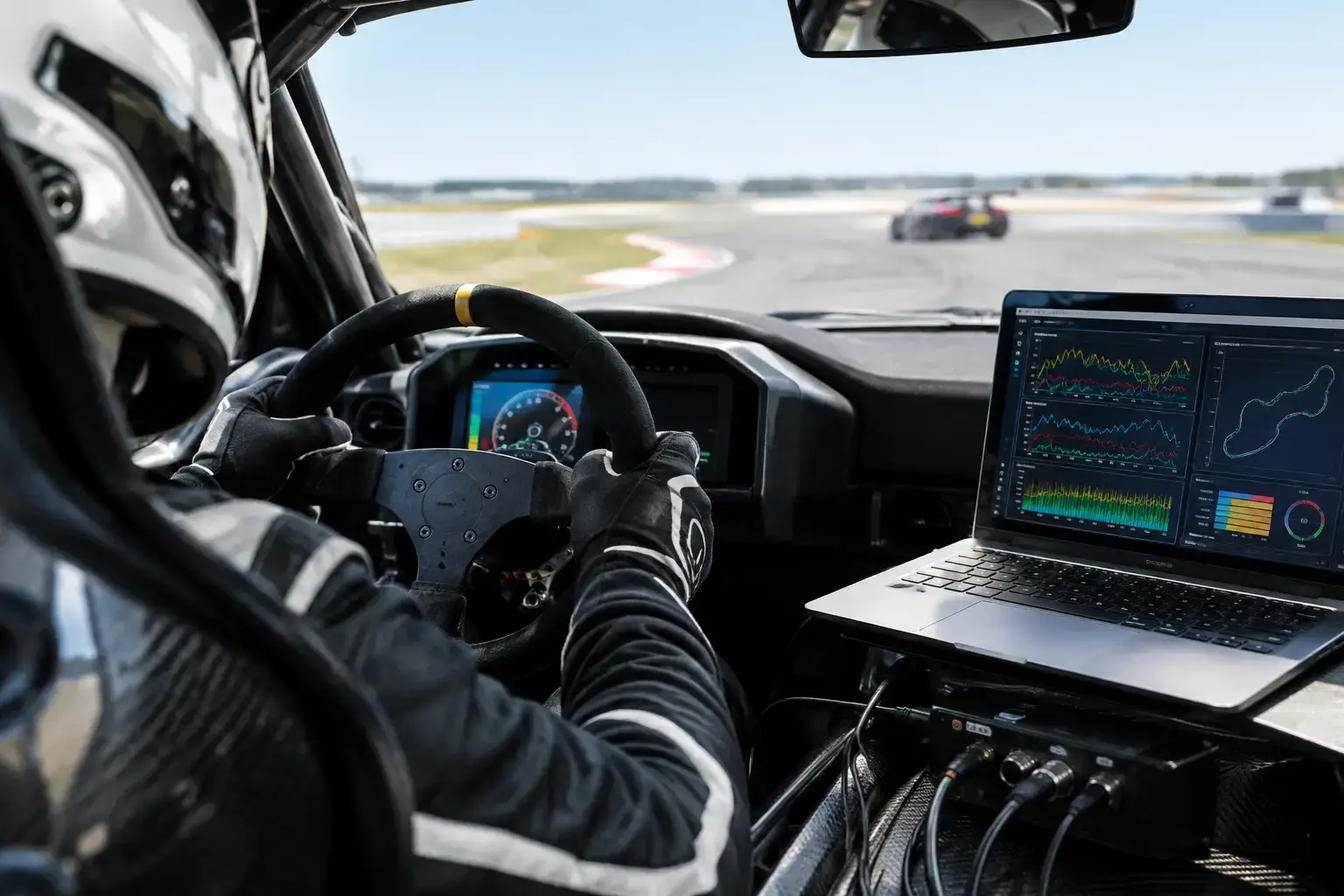
At minimum, a track data system needs accurate GPS position, lap timing, speed, and ideally a method to see throttle and brake application. A logger that combines GPS with CAN bus or OBD data adds valuable context, including RPM, gear, coolant temperature, intake air temperature, oil temperature, boost, fuel pressure, and steering angle when available.
GPS sample rate matters. Lower-rate systems can provide reliable lap times, but they may smooth out the details that matter in a short braking zone or a fast direction change. Higher-resolution GPS and properly integrated vehicle data make overlays more trustworthy, particularly when comparing a driver’s best lap to a reference lap.
Mount the logger securely and give it a clear view of the sky. If you use a camera, synchronize it with the logger before the first session. Video is not a substitute for data, but it is excellent for confirming what happened when a trace raises a question. A sudden speed loss may be wheelspin, traffic, a missed shift, or simply a different line. Video prevents false conclusions.
Before heading to pit lane, verify that time and date are correct, the track map is loaded or can be created, channels are recording, and the system has adequate power. A failed recording after the quickest session is an avoidable frustration.
Channels That Matter Most
More data is not automatically better. Start with the channels that let you connect driver inputs to vehicle response:
- GPS speed, position, lap time, and predictive lap time
- RPM, gear, throttle position, and brake pressure or brake switch
- Steering angle, where supported
- Coolant, oil, intake air, and transmission temperatures
- Boost, lambda or air-fuel ratio, and fuel pressure on forced-induction cars
- Wheel speeds, lateral G, longitudinal G, and tire pressures or temperatures when the system supports them
On a high-output turbo car, fuel pressure and intake temperature deserve close attention. A clean power curve is only useful if the fueling system maintains pressure and the charge-air system controls heat over repeated laps. On a car with upgraded brakes and suspension, brake pressure and wheel speed data can be just as revealing as engine channels.
Establish a Clean Baseline First
Do not compare a warm-up lap with traffic to an all-out flyer and call the differences setup gains. Create a baseline from several clean laps in similar conditions. Note ambient temperature, track temperature, tire model, cold pressures, fuel load, alignment settings, damping changes, and any power calibration in use.
A baseline does not need to be the fastest lap of the day. In fact, a repeatable sequence of laps within a few tenths is often more valuable. It shows how the car behaves when the driver is operating it consistently. The fastest lap may contain a heroic braking move that cannot be repeated, which makes it poor setup evidence.
When testing parts or adjustments, change one major variable at a time. If you install a new rear bar, reduce rear tire pressure, and alter damping in the same session, you may find a quicker lap but not know why. The exception is when safety or reliability requires multiple corrections at once, such as adding cooling capacity and revising a calibration on a high-boost build.
How to Read a Lap Without Chasing Noise
Open two laps side by side: a reference lap and a comparison lap. Begin with the time-delta graph, then work corner by corner. The trace will tell you where time was gained or lost, but speed, throttle, brake, and steering data explain the cause.
In a braking zone, look for brake application point, peak pressure, release shape, and minimum speed at the apex. A later brake point is not always faster. If the driver brakes later but releases abruptly, misses the apex, and delays throttle, the lap often loses time from mid-corner through exit. The better trace may show earlier braking with a smoother release and a higher minimum speed.
On corner exit, compare the moment throttle begins to open, the rate at which it reaches full application, and the resulting speed trace. If a driver goes full throttle earlier but speed does not respond, the car may be wheelspinning, traction-control intervention may be active, or the line may be too tight. Wheel-speed data can confirm slip. Without wheel speeds, video and a mismatch between throttle and acceleration can still point in the right direction.
Steering angle helps diagnose whether the front tires are overloaded. More steering lock with less speed is rarely a winning combination. It can indicate entry speed that is too high, inadequate front grip, excessive understeer from setup, or a driver waiting too long to rotate the car. Do not blame hardware immediately. Compare multiple corners and multiple laps before deciding whether the pattern is in the chassis or the driving.
Use Segment Analysis, Not Only Best Laps
A best theoretical lap can be motivating, but it can also mislead. It combines the strongest sector from different laps, sometimes taken with different tire temperatures, fuel loads, or traffic conditions. Use it as a clue, not a target that must be achieved in one lap.
Segment analysis is more practical. Break the circuit into braking zones, technical complexes, and long exits. If a change gains two tenths in one section but loses four tenths in another, it is not an improvement. This matters when adjusting suspension or aero balance, where a setup may sharpen low-speed rotation but make high-speed sections nervous.
Turn Data Into Setup Decisions
The strongest setup decisions come from a pattern, not a single trace. For example, consistently rising intake temperatures followed by falling acceleration on a turbocharged lap suggests a heat-management issue. Confirm with repeated sessions, then inspect the cooling package, airflow path, intercooler efficiency, and calibration strategy. Do not assume peak boost alone tells the whole story.
Likewise, a driver who repeatedly reaches a corner with similar brake pressure but cannot carry minimum speed may be dealing with front-end grip, tire pressure, alignment, or entry technique. If front tire temperatures are excessive on the outer shoulder, alignment and pressure are worth investigating. If temperatures are even but steering angle climbs, the answer may be line choice or a car that needs more rotation.
Keep a setup sheet with every adjustment and its result. Record objective data, driver feedback, weather, and tire condition. Driver feedback remains essential because the fastest setup on paper is useless if it is unpredictable at the limit. The right answer depends on the car, driver, track layout, tire, and event format.
For enthusiasts building serious European track cars, EAS Store can help narrow component choices around the platform and performance target. Fitment, power level, and intended use matter as much as a part’s reputation.
Avoid the Most Common Logging Mistakes
The biggest mistake is treating data as a verdict rather than a tool for asking better questions. GPS drift, sensor calibration, inconsistent tire condition, traffic, and changing weather can all create misleading comparisons. Review the quality of the session before reacting to a trace.
Another common error is focusing only on peak numbers. Peak lateral G, top speed, and maximum brake pressure look impressive, but the shape and timing of the trace usually matter more. A smooth driver who carries speed and releases the brakes progressively can be quicker than someone producing bigger spikes.
Finally, avoid making a mechanical change to solve a driving inconsistency. If braking points vary by 30 feet from lap to lap, improve the reference point and driver process before changing pad compound or suspension settings. Data works best when it builds discipline in both the cockpit and the garage.
Bring the same method to every event: establish a baseline, test one meaningful change, and verify the result over repeatable laps. The stopwatch will show whether the lap improved. Good data will show you how to make that improvement happen again.