A G8X track cooling example should start with the conditions that actually create heat: long sessions, high ambient temperatures, sticky tires, sustained boost, and a driver who is not backing off after two quick laps. The BMW S58-powered M3 and M4 arrive with a capable factory thermal package, but track use changes the equation quickly. Once power rises, airflow is restricted, or sessions stretch into summer heat, cooling needs to be treated as a system rather than a single part purchase.
For the serious enthusiast, the goal is not simply the lowest possible coolant temperature. It is stable performance over a full session, predictable oil and charge-air temperatures, and enough thermal margin that the car is not pulling power just when the track is fastest.
What a G8X Track Cooling Example Looks Like
Consider a G80 M3 Competition or G82 M4 Competition running a conservative performance calibration, upgraded downpipes where legal, high-flow intake components, performance brake pads, and 200-treadwear tires. It is driven at several road-course events per year, including warm 85 to 100-degree days, with 20- to 30-minute sessions. This is a common use case: a fast street car that needs to complete repeatable track laps without becoming a dedicated race car.
On a mild day with stock power, the factory cooling system may be entirely adequate. Add higher boost targets and grip, however, and the car spends more time at wide-open throttle while producing substantially more heat. The driver may see coolant, engine oil, intake-air, transmission, or differential temperatures climb later in the session. Which reading matters most depends on the car, its calibration, the circuit, and the data available through the factory display or logging software.
That is why the right upgrade plan begins with evidence. Log several representative sessions before ordering parts. Record ambient temperature, session length, top speed, coolant temperature, oil temperature, intake-air temperature, and any power reduction or warning messages. A single hot lap is not enough. The useful data is what happens after 10, 15, and 20 minutes of sustained running.
Find the Heat Bottleneck Before Buying Parts
The S58 uses multiple cooling circuits and heat exchangers, so there is no universal answer to every G8X cooling complaint. A car with rising intake-air temperatures under repeated boost may benefit most from improved low-temperature cooling capacity. A car with elevated engine oil temperatures may need attention in a different area. A vehicle that only struggles in traffic after a session may point toward airflow management, fan operation, or heat soak rather than a lack of radiator capacity.
Start by confirming the basics. The factory heat exchangers must be clean and free of packed rubber debris, insects, leaves, and track pickup. The G8X front end has a dense stack of cooling hardware, and restricted airflow through one layer affects every component behind it. Inspect ducting, undertrays, seals, hoses, coolant level, and radiator fins before assuming a larger part is required.
Also separate normal temperature movement from a genuine thermal limitation. Oil temperature rising during a hard session is expected. Temperatures that continue climbing lap after lap, trigger a protection strategy, or require an early cooldown are the real concern. The same applies to charge-air temperatures. A brief rise after a straight is different from a continuous upward trend that reduces consistency across a session.
Example: The Warm-Weather Stage 1 Track Car
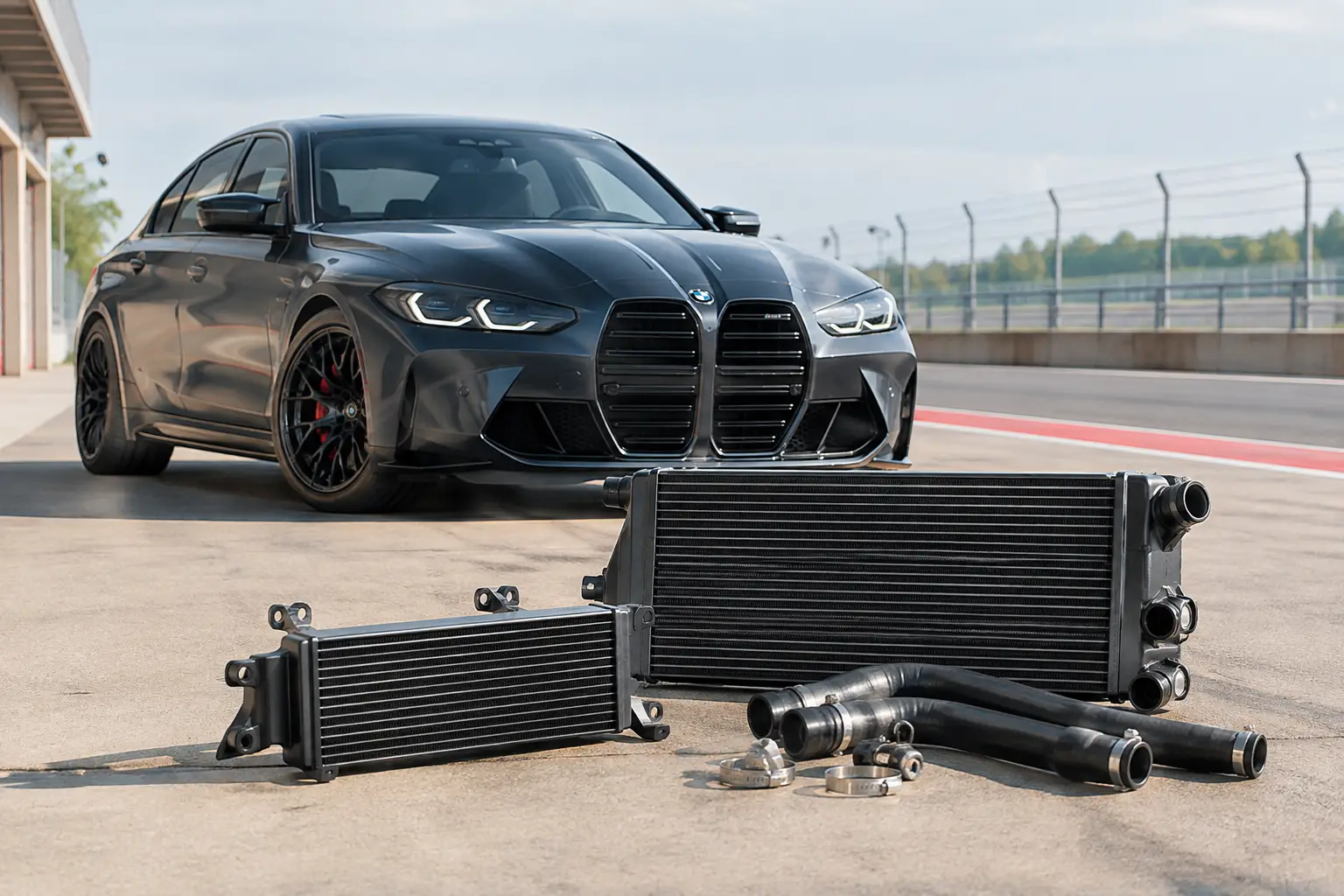
For the example G8X, the first targeted upgrade would typically be a larger, higher-efficiency heat exchanger for the low-temperature circuit. This is often the most logical starting point for a tuned S58 that sees repeated boost events, especially on a hot road course. More core volume and better heat transfer can give the system additional reserve, helping it recover more effectively between corners and across consecutive laps.
A quality heat exchanger must fit the G8X cooling architecture correctly. Core size alone is not the whole story. Proper mounting, port design, pressure drop, airflow through the stack, and compatibility with factory or upgraded hoses all influence real-world results. An oversized core with poor duct sealing or compromised airflow can underperform a carefully engineered unit designed specifically for the chassis.
At this stage, fresh coolant mixed to the correct specification and concentration is worthwhile if service is due. It is not a substitute for hardware, and stronger concentration is not automatically better for track use. Follow the coolant manufacturer and vehicle requirements, avoid mixing incompatible fluids, and bleed the system correctly. Air trapped in a cooling circuit can create inconsistent readings and make diagnosis far more difficult.
For a car that is otherwise healthy, this first step may be enough. If intake-air temperatures stabilize and the car completes full sessions without a reduction in performance, there is no prize for adding unnecessary parts. Cooling upgrades should match the actual duty cycle, not an internet parts list.
Example: The Higher-Output, High-Ambient Build
Now take the same G8X and raise the demand. The car has a more aggressive calibration, upgraded turbochargers or fueling support, significantly higher output, and regular events in desert or humid summer conditions. It may also run aero components that increase downforce but change the pressure and airflow behavior around the front of the car. Here, the low-temperature heat exchanger remains central, but it should be part of a broader package.
Additional radiator capacity or an upgraded engine-cooling solution may make sense if engine coolant trends upward under load. An upgraded engine oil cooler can be appropriate when oil temperature is the limiting value. Transmission and differential cooling deserve attention for cars doing long sessions, high-speed events, standing starts, or competition use. These systems are often ignored until heat protection appears, yet they carry their own sustained-load demands.
The correct package is determined by the bottleneck. If charge-air temperatures are under control but engine oil is still climbing, installing another charge-air component will not solve the issue. If transmission temperature is stable, an auxiliary transmission cooler may add cost, plumbing complexity, and potential pressure-drop concerns without meaningful benefit. This is where targeted product selection matters more than buying the biggest available part in every category.
Airflow Is Part of the Cooling System
A larger heat exchanger cannot perform at its best if air takes the easy route around it. Factory ducting, shrouds, seals, bumper openings, and underbody panels all help establish the pressure differential that moves air through the cooling stack. Missing undertrays or loosely fitted aftermarket bodywork can hurt high-speed cooling, even if they appear unrelated to the radiator.
For track-oriented G8X builds, inspect the front end after every event. Clear debris from the heat exchangers, check for bent fins, and make sure no silicone coupler, wiring loom, or auxiliary component blocks a major airflow path. If the car uses an aftermarket bumper, grille, or brake ducting, verify that those changes do not starve the main cooling openings.
There is a trade-off here. More open frontal area can improve airflow, but it can also expose coolers to more debris and affect aerodynamic balance. Brake ducts can lower brake temperatures while competing for packaging space. Every modification should be evaluated as part of the full vehicle, particularly on cars using splitters, canards, or aggressive underbody aero.
Installation Quality Matters on a Track Car
Premium cooling hardware only delivers its intended value when installed correctly. A track car sees repeated heat cycles, vibration, curbing, and high system pressure. Use the proper clamps, verify hose routing and clearance, torque brackets correctly, and pressure-test the system after installation. Recheck connections after the first heat cycle and again after the first event.
Bleeding procedure is equally critical on the G8X. Follow the applicable BMW service process for the specific circuit being opened. A rushed fill can leave pockets of air that lead to erratic temperature behavior, weak heater operation, or localized hot spots. If the car is being built at a shop, request a clear record of what fluid was used, what circuit was serviced, and whether the system was pressure-tested.
This is also the time to think about service access. A complex cooling package may offer major capacity gains, but competition-focused parts can require more involved maintenance. For a car driven to events and used on the street, the best setup is often the one that delivers stable temperatures without making routine inspection unnecessarily difficult.
When to Add More Cooling
Add capacity when logged data supports it, not because another car needed it. A stock-turbo G8X on occasional track days may need only a well-designed heat exchanger and careful maintenance. A high-output car on slicks, driven in triple-digit temperatures, may require multiple upgraded circuits and closer monitoring. Weight, budget, intended session length, and the availability of quality installation all matter.
EAS Store supports performance builds where fitment and system matching are as important as peak horsepower. For the S58 platform, select cooling components by the circuit they address, the power level they support, and the environment where the car will actually be driven.
The useful closing thought is simple: build enough thermal reserve for the last five laps, not just the first fast one. A properly planned G8X cooling package lets the driver focus on braking points and corner exits instead of watching temperature warnings.